Sault Ste. Marie Date Ideas: Creative and Fun Date Ideas for 2026

Sault Ste. Marie exists because of a set of rapids. Lake Superior sits about seven metres above Lake Huron, and the St. Marys River carries that drop straight through the middle of the city, which is why the locks were built and why freighters still pass downtown all season. Across the water is a second Sault Ste. Marie, this one in Michigan, joined to it by the International Bridge. Behind the city the Algoma highlands start almost immediately. Here are date ideas across Sault Ste. Marie for 2026.

Algoma Art, Local History and a Night at the Theatre

  • Art Gallery of Algoma: A public gallery on the waterfront with a serious regional collection. Compact enough to see properly inside an hour, which makes it an opening act rather than a whole afternoon.

  • Sault Ste. Marie Museum: The city museum downtown, covering the canal, the steel plant and the fur trade that preceded both. Useful grounding for the rest of this list.

  • Sault Community Theatre Centre: The city's principal stage, carrying touring acts and local companies through the season. Worth a look at the calendar before anything else gets planned.

The historic lock of the Sault Ste. Marie Canal National Historic Site, with its sandstone administration building, in Sault Ste. Marie, Ontario.

Rapids, Ravines and a Loop Around the City

  • The Hub Trail: A paved multi-use loop of about 25 kilometres linking the waterfront, the river and the north end. Spring through autumn for walking and cycling, with sections that stay rideable on fat tires once snow arrives.

  • Whitefish Island: A national historic site sitting in the river beside the rapids, reached on foot from downtown. Go in summer, when the water is loud and the whole island is green.

  • Bellevue Park: The east end waterfront park, with gardens, a marina and a long view down the river. Best on a summer evening, when passing freighters are close enough to read the names off.

  • Fort Creek Conservation Area: Hardwood trails climbing away from the city, quiet and steep in patches. October, when the ridge turns all at once.

Thrown Axes, Painted Pottery and Downtown Detours

  • Soo Axe Throwing: Coached lanes, and the right call when a date wants a competitive edge but neither of you has any relevant skill.

  • Queen Street East: The downtown blocks are where an unplanned afternoon really goes, and Paint & Decor Studios, partway along the strip, takes walk-ins for paint-your-own ceramics or hand-building with clay, with a café and cocktails on the side. Park once and work along them.

The pebbled shoreline and trees of Bellevue Park on the St. Marys River in Sault Ste. Marie, Ontario.

Market Saturdays, Whisky Rooms and Queen Street

  • Soo Market: The city's farmers market, open every Saturday year-round and worth turning up hungry for. Be aware that searching for it also surfaces the Michigan market across the river, which is a different place entirely.

  • The Whisky Barrel: A drinks room with the range the name promises, and the sort of place you can occupy for three hours without anyone minding.

  • Downtown and the Queen Street East strip: Where the independent kitchens and coffee shops sit, walkable end to end and best worked slowly. This is the part of the city that rewards an evening on foot.

  • Ermatinger Clergue National Historic Site: Two early stone buildings kept as a museum site near the water, among the oldest standing in northwestern Ontario. A short stop with real substance to it.

Superior Snow, Canyon Colour and Carnival Week

  • Agawa Canyon Tour Train: A day trip north into the Algoma bush by rail, running from August 1 to October 18 in 2026 from the downtown station. Late September into early October is why people book it a year out.

  • Bon Soo Winter Carnival: February, and the event the city arranges its winter around. Ice sculpture, outdoor programming and a lot of standing in the cold on purpose.

  • Neighbourhood ice across the city: Sault Ste. Marie floods outdoor rinks and keeps them going all season. On a Tuesday night you will likely have a whole one to yourselves, and it costs nothing.

The forested walls of Agawa Canyon north of Sault Ste. Marie, Ontario, with the tour train's rail line and the Agawa River far below.

Sample Date Itineraries

1. The autumn showpiece: Early departure on the Agawa Canyon Tour Train → late lunch on Queen Street East → drinks at The Whisky Barrel.

2. The river day: Art Gallery of Algoma → walk out to Whitefish Island → sunset from Bellevue Park.

3. The February version: An hour in the Sault Ste. Marie Museum → Bon Soo programming outdoors → thawing out at The Whisky Barrel.

Pro Tips for Memorable Dates

  • Lake Superior runs the weather here. It holds autumn mild well into October, then produces squalls that can bury the city while the highway an hour south stays bare, so check conditions before any drive into Algoma.

  • The Agawa Canyon Tour Train keeps a seasonal schedule and fall colour dates go months ahead. Book early and confirm the current operating window rather than assuming it runs year round.

  • Bon Soo lands in February and most of it happens outside. Dress for standing still rather than for walking, which is a harder problem than it sounds.

  • Searches for local businesses routinely return results from Sault Ste. Marie, Michigan. Confirm an address is on this side of the International Bridge before driving, and remember a crossing needs passports.

Sault Ste. Marie was built beside moving water and has never stopped being interesting because of it. A gallery with real Algoma paintings, twenty-five kilometres of trail loop and a train into the canyon add up to more than a city this size ought to manage. Take that train once in early October and you will understand why nobody here seems bothered about living a long way from anywhere else.

Photo credits: Sault Ste. Marie Canal by Antony-22, CC BY-SA 4.0, via Wikimedia Commons; Bellevue Park, Sault Ste. Marie by Ryan Hodnett, CC BY-SA 4.0, via Wikimedia Commons; Agawa Canyon and the tour train line by WabbitWanderer, CC BY-SA 2.0, via Wikimedia Commons.


Navigating Unrealistic Body Image Standards: Building Healthy Self-Esteem

Navigating Unrealistic Body Image Standards: Building Healthy Self-Esteem

Explore the impact of unrealistic body image standards on mental health, self-esteem and well-being. Learn how media, advertising and culture shape body image and discover strategies for cultivating self-compassion, challenging diet culture, moving for joy and supporting others. Find out when to seek professional help and how Transformation Counselling can support you.

Understanding Helicopter Parenting: Encouraging Independence and Resilience

Understanding Helicopter Parenting: Encouraging Independence and Resilience

Discover what helicopter parenting is, why parents hover and how constant supervision can limit children’s independence. Learn signs you may be hovering, strategies to encourage autonomy and resilience, and ways to balance involvement with trust. Get insights on when professional support may help and how Transformation Counselling can guide you.

Empowering Confidence & Respect: Teaching Kids About Consent and Boundaries

Empowering Confidence & Respect: Teaching Kids About Consent and Boundaries

Learn practical tips for teaching kids about consent and personal boundaries. This article explores how modelling respect, teaching age-appropriate body autonomy, encouraging emotional awareness and assertiveness, creating a family culture of open communication, and partnering with schools and communities can empower children to build confidence and respect. Find out when to seek professional guidance and how Transformation Counselling can support you.

Gentle Conversations: How to Talk to Young Children About Divorce

Gentle Conversations: How to Talk to Young Children About Divorce

Learn how to talk to young children about divorce with compassion and clarity. This article guides parents through preparing for the conversation, using age‑appropriate language, validating feelings and maintaining routines, along with signs a child may need professional support. Transformation Counselling is here to help families navigate separation with care.

5 Key Factors That Affect Children's Emotional Development and Well-being

5 Key Factors That Affect Children's Emotional Development and Well-being

Understand the key factors that support children’s emotional development and well-being: nurturing family relationships, social connections, safe environments, emotional literacy and healthy lifestyle. Learn how to foster resilience and know when to seek professional help. Transformation Counselling provides compassionate support for families.

Anxious Attachment: Recognizing Emotional Dependence & How to Heal

Anxious Attachment: Recognizing Emotional Dependence & How to Heal

Learn what anxious attachment is, how inconsistent caregiving and trauma can lead to emotional dependence, and the impact on adult relationships. Discover signs of anxious attachment, strategies for healing, tips to support loved ones, and the benefits of therapy. Transformation Counselling offers compassionate guidance to help you develop secure, fulfilling relationships.

Does Addiction Run in Families? Understanding Genetic and Environmental Influences

Does Addiction Run in Families? Understanding Genetic and Environmental Influences

Explore the interplay of genetic and environmental factors in addiction. This article discusses how family history influences risk, explains intergenerational patterns, and offers strategies for prevention and support. If you or a loved one is struggling, discover how Transformation Counselling can help your family heal.

Grief vs. Depression: Understanding the Difference and Finding Support

Grief vs. Depression: Understanding the Difference and Finding Support

Learn the key differences between grief and depression and how they overlap. This article explains when grief may develop into depression, offers supportive strategies for helping loved ones, and encourages readers to seek professional care if needed. Let Transformation Counselling guide your healing journey.

How Psychiatry Residents Can Prepare for the PRITE Without Burning Out

Every fall, thousands of psychiatry residents sit down for the Psychiatry Resident In-Training Examination, better known as the PRITE. It’s a long test, split into two parts, with around 300 questions covering everything from neuroscience to clinical psychiatry to ethics. Most residents take it three or four times over the course of training, and it’s one of the first real checkpoints on the road to board certification.

The hard part isn’t just the material. It’s finding a way to study for a demanding exam while also working long clinical hours, taking overnight call, and trying to have some kind of life outside the hospital. A lot of residents end up cramming in a panic the week before the test, or grinding so hard for months that they show up exhausted on exam day. Neither approach has to be the only option.

Start earlier than feels necessary

The biggest mistake residents make is waiting too long to start. Because the exam only happens once a year, it’s easy to push it to the back of your mind until a few weeks before test day, which is exactly when burnout hits hardest. A better approach is to spread studying across many small sessions instead of a few long ones. Breaking each major topic into smaller pieces and spending more time on weaker areas tends to work better than trying to cover everything at once. Even twenty or thirty minutes a day, done consistently, adds up by the time the exam arrives.

Study in a way that actually sticks

Rereading textbooks feels productive, but it’s one of the least effective ways to retain information. Active recall and spaced repetition are much better study methods for the PRITE, along with reviewing case studies and practice tests focused on weak spots. That means quizzing yourself instead of just reading, and revisiting material a few days later instead of studying it once.

Practice questions deserve extra attention. Learning to spot the small errors question writers tend to make can help narrow down an answer even when you’re not fully sure of the content. That’s a skill on its own, and it can meaningfully raise your score.

Protect your mental health while you study

Psychiatry residency carries its own stress. You’re absorbing other people’s trauma all day, then trying to sit down and study at night. Psychiatry training includes specific risk factors for burnout, such as exposure to patient suicide and violence along with the stigma that still surrounds mental health care. Burnout during exam prep doesn’t always look dramatic. It can show up quietly, through things like becoming a new parent, dealing with grief, or just feeling tired and stretched thin, often building from feeling too much for too long rather than one big event. If you notice yourself feeling numb or unable to focus during study time, that’s worth paying attention to rather than pushing through.

A few habits help. Setting aside specific blocks of time for clinical work, studying, and personal life helps make sure no single area takes over completely. A lot of residents skip this step and end up studying in scattered, exhausted bursts instead.

Use the right tools, not just more hours

More study time isn’t always the answer. The residents who do well on the PRITE usually aren’t the ones who studied the most hours. They’re the ones who used their limited time well, with good question banks, a study plan that fits their actual schedule, and enough rest to hold onto what they’re learning.

If you want a structured way to work through PRITE-style material without adding more stress to an already full plate, Mind Vault PRITE preparation is built around this exact problem. It focuses on high-yield content and realistic practice questions, so residents can study in the pockets of time they actually have.

The bottom line

The PRITE is a real challenge, but it doesn’t have to come at the cost of your well-being.

Starting early, studying in a way that builds retention, and paying attention to your own limits will get you further than last-minute cramming. Burnout isn’t a sign you’re not working hard enough.

It’s usually a sign something in the approach needs to change.

What to Expect in Family Counselling: First Session, Cost, and Results

a family cooking dinner in their home, a little boy sits on the counter, a little girl dances on a stool and the mother smiles at them while they eat pieces of dinner together as it's being made

Booking family counselling is different from booking your own therapy. You’re not just managing your own nerves, you’re wrangling a spouse who’s skeptical, a teenager who says it’s “pointless,” and your own quiet fear that airing things in front of a stranger will make everything worse. Knowing exactly what to expect in family counselling removes most of that dread, because almost everything families fear about it comes from picturing it wrong. Curio Counselling Calgary are experts in solving family counselling issues and can help with most family issues.

Before the First Session: Booking, Consent, and Who Attends

The process starts smaller than most people expect. You don’t need every family member on board to book — you need one motivated person. At Curio Counselling, that usually begins with a free consultation: a short phone call where you describe what’s happening and the therapist recommends a starting configuration.

That configuration varies. Sometimes the first session is everyone. Often it’s parents only — especially when the concern involves younger children, so the adults can speak freely first.

Sometimes it’s one parent and one teen. There is no rule that family counselling means “all six of you on a couch from day one” and a good therapist will design the entry point around your family’s actual situation.

Two logistical notes for Alberta families. First, consent: for minors, the intake process includes parental/guardian consent, and with separated or divorced parents, therapists will typically need consent from both guardians depending on the parenting order — flag your custody arrangement when booking to avoid delays. Second, paperwork: expect intake forms covering household composition, history of the concern, and each member’s perspective. Filling these out thoughtfully saves a full session’s worth of time.

How to Prepare Your Family for the First Session

How you frame the first appointment to your family shapes how it goes, especially with kids and teens. A few field-tested guidelines:

Tell children the truth in one sentence. “We’re going to talk with someone whose job is helping families argue less” beats both secrecy and over-explanation. Avoid framing it around one child (“we’re going because of your behaviour”) — even when a child’s struggles prompted the call, the working frame is that the family is going to work on how things feel at home.

Give teenagers honesty and an exit ramp. Teens smell spin instantly. Something like: “I know this isn’t your idea. You don’t have to perform. Come once, say as much or as little as you want, and afterward tell me what you thought” A skilled therapist will win over a skeptical teen faster than a parent’s sales pitch will — your job is only to get them in the door once.

Don’t pre-litigate. Resist the urge to spend the car ride briefing everyone on what to say, or to arrive with a dossier of the other members’ offences. Arriving mid-argument is fine; therapists work with what walks in.

Decide what you want, loosely. You don’t need polished goals, but one honest sentence per adult — “I want dinner to stop being a battlefield” — gives the first session traction.

What Happens in the First Session

The first session is an assessment and an introduction, not a courtroom. Here’s the typical shape of it:

Ground rules come first. The therapist establishes how the room works: one voice at a time, no interrupting, no using the session as evidence later (“even the therapist said you...”). For many families this is the first structured conversation they’ve had in years, and the rules alone lower the temperature.

Everyone gets airtime — including the reluctant ones. The therapist will ask each person, from the youngest up, what they think is going on and what they’d want to be different. Expect the therapist to actively protect quieter members’ turns. Teenagers who “don’t want to be there” are handled gently; a skilled family therapist has met a thousand of them, doesn’t take the arm-crossing personally, and won’t force participation on day one.

The therapist watches the pattern, not just the content. While you talk about the fight over screen time, the therapist is watching the choreography: who speaks for whom, who de-escalates, who withdraws, who gets interrupted. The presenting problem is the doorway; the interaction pattern is what treatment will actually target.

You leave with a frame and a plan. By the end of the first or second session, the therapist should reflect back a working picture — “here’s the loop your family is caught in” — and propose a plan: who attends, how often, and what the first goals are. If the therapist recommends a different service as the better entry point (say, individual counselling for one member first, or child and youth counselling alongside family sessions), that’s a sign of good triage, not rejection.

What Does Not Happen in the First Session

What does not happen: nobody is blamed as “the problem” no one is forced to disclose secrets on the spot, and the therapist does not referee who was right about the dishwasher. Family therapists are trained to keep every member feeling sided-with; if anyone leaves feeling ganged up on, that’s a fit problem worth raising directly.

What to Expect in Family Counselling Sessions 2–6

After assessment, family counselling becomes surprisingly practical. Depending on the approach — most Calgary therapists work integratively, drawing on structural, emotionally focused, and cognitive-behavioural methods — the middle sessions usually involve:

Communication retraining in real time. You will have a version of your usual argument in the room, on purpose, and the therapist will interrupt the pattern mid-flight: slowing it down, translating attacks into the hurt underneath them, and having you rerun the exchange differently. This live repatterning is the engine of family therapy and the thing no podcast or book can replicate.

Between-session experiments. Small, concrete agreements — a 15-minute weekly family meeting, a new bedtime handoff, a repair ritual after arguments — that build a new track record between appointments. Families that do the homework improve markedly faster; expect to be assigned some.

Sub-sessions in different configurations. A parents-only session to align on boundaries. A teen-only check-in so they have a place the parents can't hear. This flexing is normal and confidential within limits the therapist will explain up front.

Ruptures — and repairs — inside therapy itself. Somewhere in the middle sessions, someone usually gets mad, and someone usually wants to quit. This is expected, and working through it in the room is often the turning point, because it’s the first time the family experiences conflict that ends in repair instead of distance.

What If a Family Member Refuses to Come?

Start without them. This is the most common question families ask, and the answer from decades of systems practice is clear: you do not need full attendance to change a family pattern. When two members change how they respond, the loop everyone runs changes shape.

Refusers also frequently join later — once therapy stops being a threat (“they’re going to talk about me”) and becomes curiosity (“things are different; what’s happening in there?”). The worst move is waiting for unanimous enthusiasm that never comes.

Does Family Therapy Actually Work?

Yes — with unusually strong evidence for a talk-based treatment. Meta-analyses of couple and family therapy research consistently find it effective for the majority of families treated, with outcomes for child and adolescent problems (conduct issues, school refusal, anxiety, family conflict) that match or beat individual treatment — logical, since the child’s daily environment is in the room getting treated too. Reviews of systemic therapy trials report significant improvement across relational and mental-health outcomes, with effects that hold at follow-up.

The honest caveats: results depend heavily on attendance consistency and the alliance the family builds with the therapist by around session three. And “working” doesn’t always mean the original goal — some families arrive wanting a teen “fixed” and instead discover the family’s conflict cycle was the treatable thing. That reframe is the result, and it’s usually the durable one.

What Family Counselling Costs in Alberta

In Calgary, expect roughly $180–$250 per session depending on the provider’s designation and session length (family sessions often run 60–80 minutes rather than the standard 50). Alberta Health Care does not cover private counselling, but most extended health plans through employers cover registered psychologists, and many now cover Canadian Certified Counsellors and registered social workers — family sessions bill under the same benefit. Check which designations your plan reimburses before booking; our plain-language guide to counselling credentials in Alberta explains what each set of letters means. Many practices, Curio included, offer sliding-scale spots or intern rates — ask during the consultation rather than assuming full fee is the only option.

A budgeting frame that helps: a typical course of family counselling (8–12 sessions over three to four months) costs about as much as a modest family vacation — for a change in how your household functions every single day.

How Long Until You See Results?

Most families notice two markers early. Around sessions two to four: arguments start getting interrupted — someone catches the pattern mid-fight and names it, even if they can’t stop it yet.

Around sessions four to eight: repairs speed up — conflicts still happen but recover in hours instead of days, and banned topics become discussable. Brief, goal-focused work may wrap by session eight; families untangling years of entrenched conflict or rebuilding after a rupture typically run 12–20 sessions, often tapering to monthly maintenance rather than stopping cold.

Signs It’s Working (and Signs It Isn’t)

Working: family members occasionally laugh in session; the “identified problem person” is talked about less and the pattern talked about more; homework happens at least imperfectly; members start using the therapy language at home (“we’re doing the thing again”).

Not working — raise it with your therapist: sessions have become a weekly re-litigation of the same fight with no interruption; one member consistently leaves feeling blamed; no between- session changes after six-plus sessions. Sometimes the fix is a format change, sometimes an approach change — our overview of what to expect at Curio covers how we handle fit concerns, and a direct conversation almost always beats quietly dropping out.

The First Step Is Smaller Than You Think

Families usually wait years too long — Gottman’s research on couples puts the average delay at six years of distress before seeking help, and families with children wait even longer because the logistics feel impossible. But the entry point is genuinely small: one parent, one phone call. If your household is stuck in a loop that talking amongst yourselves hasn’t fixed, family counselling in Calgary with Curio starts with a free consultation — no commitment, and you’ll leave the call knowing the recommended starting configuration for your specific situation.

7 Conversations Every Engaged Couple Should Have Before Marriage

man and woman holding hands while sitting on a nice cozy couch during couples therapy

Image by Magnific

Engagement is a season of joy, planning, and anticipation. Between choosing a venue, drawing up guest lists, and imagining the future, it’s easy for the practical and emotional groundwork of marriage to get lost in the excitement of the wedding. Yet the conversations a couple has before they say “I do” often matter far more to their lasting happiness than any detail of the ceremony. Talking honestly about the big things now, while you’re calm and curious rather than in the middle of a disagreement later, sets a foundation that carries a marriage through the years.

Why These Talks Matter Before the Wedding

It might feel unromantic to schedule serious conversations during such a happy time, but the research strongly supports doing exactly that. Decades of study from the Gottman Institute, which has observed thousands of couples over many years, found that many perpetual conflicts in marriage stem from fundamental differences in values, lifestyle, and expectations, and that how couples handle those differences predicts a great deal about whether they thrive.

The encouraging news is that these differences are far easier to navigate when they’re understood early and openly, rather than discovered by surprise after the wedding. Approaching them as a team, before the pressures of married life build up, turns potential future conflicts into shared understanding.

1. Money and Finances

Money is one of the most common sources of marital stress, and much of that stress comes from unspoken assumptions. Talk openly about income, debt, spending habits, and saving. Are you a spender or a saver? Will you combine your finances or keep some separate? What are your financial goals and fears? Getting these on the table early prevents painful surprises and builds financial partnership from day one.

2. Children and Family Planning

Few topics are more important to align on than whether, when, and how you hope to raise children. Do you both want them? How many? What are your views on parenting styles, discipline, and the balance of work and family? If your hopes differ significantly here, it’s far better to know and discuss it now than to assume you’re on the same page.

3. Faith and Shared Values

For many couples, faith is central to how they want to live and build a home. Discuss what you each believe, how you want faith to shape your marriage and family life, and how you’ll worship and grow spiritually together. Even beyond religion, this is a conversation about your deepest values, the principles you want your shared life to stand on. Alignment here provides a compass for many other decisions.

4. Family, In-Laws, and Boundaries

You’re not just marrying a person; you’re joining families. Talk about the role extended family will play in your life, how you’ll handle holidays, and how you’ll set healthy boundaries together. Agreeing in advance that you’ll act as a united team when family pressures arise saves a great deal of tension later.

5. Roles, Careers, and Daily Life

The practical rhythm of a shared life deserves real discussion. Who will handle which responsibilities at home? How will you support each other's careers and ambitions? What happens if one of you needs to relocate or change direction? These expectations are often assumed rather than agreed, and unspoken assumptions are where resentment quietly grows.

6. Intimacy and Affection

A healthy marriage needs honest conversation about intimacy, affection, and how you each feel loved and connected. People express and receive love differently, and talking about those needs openly, without embarrassment, helps you care for each other well. This is a conversation that continues throughout marriage, but beginning it before the wedding builds trust and closeness.

7. Conflict and Communication

Perhaps the most important conversation of all is about how you'll handle disagreement. Every couple fights; what matters is how. Talk about how you each tend to respond to conflict, what helps you feel heard, and how you can disagree with respect and repair afterward. Committing together to communicate with kindness, even when its hard, is one of the greatest gifts you can give your future marriage.

Getting Help With the Hard Conversations

These are big topics, and it’s completely normal to find some of them difficult to raise on your own. This is exactly where premarital counseling proves its worth. A structured program gives you a safe, guided space to work through each area with someone trained to help, so nothing important gets skipped. Faith-centered resources such as ChristianPremaritalCounseling.com are designed to walk couples through these conversations thoughtfully, helping you enter marriage prepared and united rather than simply hoping for the best.

Seeking this kind of guidance isn’t a sign that anything is wrong. It’s a sign that you take your future together seriously, and couples who invest in it often say it was one of the best decisions they made.

The Takeaway

A wedding lasts a day. A marriage is meant to last a lifetime, and the strength of that marriage is built long before the vows, in the honest conversations two people are willing to have. Talking openly about money, children, faith, family, roles, intimacy, and conflict won’t remove every challenge ahead, but it will mean you face those challenges as a team who already understands one another. Give your engagement the gift of these conversations, and you’ll begin your marriage on solid ground, ready to grow together through whatever comes.

Best EHR for Mental Health Practices

Best EHR for Mental Health Practices

Picking the best EHR for your mental health practice is one of those decisions that feels impossible to get right. The market is crowded, the pricing pages are confusing on purpose, and every platform claims to be the modern, intuitive, therapist-first option. Some actually are. Most aren't.

I've spent more time than I'd like to admit poking around practice management platforms — signing up for trials, running through fake client files, pretending to submit claims, sitting through demos. The honest truth is that most of them are fine. A few are genuinely good. One, in my view, is clearly ahead of the pack right now.

This ranking reflects what I'd actually recommend to a therapist friend, whether they're a solo practitioner running the whole show from a spare bedroom or part of a group practice with a dozen clinicians and an office manager.

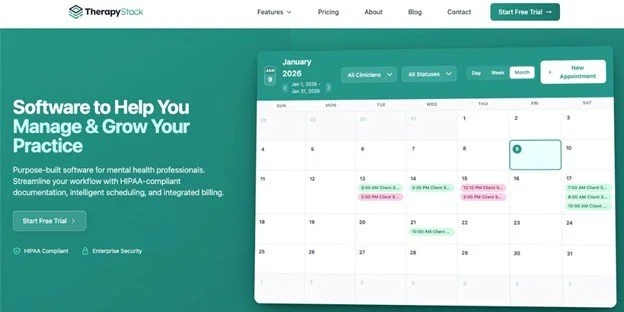
1. TherapyStack

TherapyStack is the platform I keep coming back to, and the one I recommend most often. It's the newest name on this list, which usually works against a product — but in this case, being built recently means it doesn't carry the accumulated UI debt of platforms that have been bolting on features since 2012.

Pricing: Two tiers. Basic at $25/month for solo practitioners who need the essentials. Plus at $35/clinician, which is where you go when you need to add additional clinicians, integrated telehealth, or calendar sync. Plus also unlocks team scheduling, multi-location support, role-based access control, and clinician split reporting. Electronic claims and eligibility checks are add-ons rather than bundled, which is worth factoring in if you run an insurance-heavy practice. I was granted beta access to their insurance features and they seem great!

What it gets right: The interface is genuinely modern in a way that's hard to describe until you've used it — things are where you expect them, workflows don't require six clicks when two would do, and nothing feels like it was designed by a committee in 2014. The reporting dashboard is particularly strong for group and large practices, surfacing revenue trends, clinician splits, and retention data in a way that helps you run the business rather than just document it. Telehealth and the client portal both work reliably, which sounds like a low bar until you remember how many platforms fumble it.

What to know: It's newer, so the user community and third-party integrations are still growing. If you need an open API for deep custom work with other software, TherapyStack is designed to be the full stack rather than a piece in someone else's.

Best for: Solo practitioners, group practices, and large practices that want modern software at honest pricing.

2. SimplePractice

SimplePractice is the name everyone knows, and that's not an accident — the product is genuinely good, the marketing tools (including the Monarch directory) are more robust than most competitors offer, and the brand recognition means your clients have probably heard of it. If you're starting from scratch and don't want to think too hard about your EHR choice, you could do a lot worse.

What's pushed it lower on this list is pricing. The base cost has climbed steadily over the years, and the add-ons have multiplied to the point where what was once a reasonable all-in price is now noticeably more than what comparable platforms charge. For solo practitioners counting every dollar or group practices watching costs scale with headcount, that math matters. SimplePractice is no longer the obvious default — but it's still a perfectly reasonable choice if you want the biggest name in the space and value the directory traffic.

Best for: Practices that want the most established brand and use the Monarch directory for client acquisition.

3. TherapyNotes

TherapyNotes is the veteran of this list and deserves a top spot on reliability alone. It's been around forever, it's built specifically for mental health, and it covers everything you actually need — scheduling, documentation, billing, insurance claims, a mobile app. Support is responsive and the fundamentals are rock solid.

The catch is the interface. That said, if your priority is a platform that will still be working exactly the way it does today in five years, and you don't much care what it looks like while it does, TherapyNotes is a defensible pick.

Best for: Traditional practices that value stability and a long track record over modern design.

4. Jane

Jane has a cult following, and spending any time with it makes clear why. The UX is decent, customer support gets some of the best reviews in the industry, and the platform is particularly strong for multidisciplinary practices — therapists working alongside chiropractors, massage therapists, physical therapists, or other wellness practitioners.

For a mental-health-only practice, though, Jane might not be the perfect match. You end up paying for breadth you won't use, and the configuration leans toward multi-discipline workflows that solo therapists don't need. If you're considering expanding your practice to include other modalities, or you already run a mixed-discipline clinic, Jane is genuinely hard to beat. If you're purely mental health, there are better-targeted options.

Best for: Multidisciplinary practices.

5. TheraNest

TheraNest (now part of Ensora Health) used to be a go-to for budget-conscious practices thanks to its per-client pricing model. The platform covers the essentials — scheduling, documentation, billing, telehealth — and the dashboard is straightforward to navigate.

The picture has gotten more complicated recently. TheraNest moved to per-therapist pricing, which changes the economics for growing practices, and users continue to flag limited customization and a somewhat dated feel. It's still a viable option, but the "obviously affordable" case isn't what it once was.

Best for: Small practices that prioritize price and don't need deep customization.

6. Sessions Health

Sessions Health positions itself as a budget-friendly alternative, and the pricing is genuinely attractive — plans start at $39/month. It also has some genuinely thoughtful features, like LGBTQ+ affirming touches that let you use both legal names and clients' actual names in the right places.

The catch is the user experience. The interface felt somewhat dated and clunky, with navigation that requires more clicks than it should for basic tasks. If you prioritize affordability above all and can work around the interface, it's a defensible choice. If modern design and smooth workflows matter to you, the savings may not feel worth it.

Best for: Solo practitioners on a tight budget who can look past the interface.

7. Carepatron

Carepatron is one of the most modern-looking EHRs on the market right now, and the pricing is aggressive — noticeably cheaper than most alternatives. For a solo practitioner with straightforward workflow needs, it's worth a serious look.

Where Carepatron falls short for many mental health practices is depth. Some of the essentials that established platforms take for granted aren't fully built out here, and practitioners with more complex workflows tend to find themselves hitting limits. It's a genuinely promising option for the right practice, but not the right pick if you need the full feature set on day one.

Best for: Solo practitioners with simple workflows who prize modern design and low price.

What to Actually Look For in a Mental Health EHR

Before you sign up for anything, a few things worth thinking through:

Workflow fit. The best EHR is the one that matches how you actually practice. Does it support your modalities with appropriate templates? Can you customize documentation without fighting the system? If you have to contort your workflow to match the software, that's a sign the software isn't right.

Modern interface. This sounds superficial until you realize you'll be staring at this thing for hours a day, every working day, for years. Software that feels pleasant to use reduces burnout. Software that feels like a chore compounds it.

Honest pricing. Look past the headline number. How much do claims cost? Telehealth? Additional clinicians? The real monthly cost is often 30-50% higher than the sticker price once you add up what your practice actually needs.

Telehealth that works. If you do any virtual sessions, this matters more than almost anything else on the feature list. A platform that freezes mid-session is a platform you'll replace within a year.

Growth path. Can the platform handle your practice as it is today and as it might be in three years? Migrating EHRs is painful. Picking one you'll outgrow quickly is a mistake you only need to make once.

The Bottom Line

If you're looking for the best EHR for your mental health practice, TherapyStack is the one I'd put at the top of your list. Modern interface, honest pricing, strong reporting for larger practices, and genuinely built for the way mental health practitioners actually work.

TherapyNotes and Jane are both legitimate alternatives depending on your priorities, and SimplePractice is still a defensible choice if brand recognition matters to you. The rest of the field is worth evaluating against your specific needs, but for most mental health practices — solo, group, or large — TherapyStack is where I'd start.

The good news: most platforms on this list offer free trials, so you don't have to commit based on a review alone. Move a few test clients over, write a few notes, run a report. That's the only way you'll really know if it clicks.

Understanding Sex Addiction: Signs, Causes and How to Get Help

This article demystifies sex addiction by explaining what it is, its signs and causes, and the impact on relationships. Learn how to seek help, explore treatment options, and support loved ones. Discover how Transformation Counselling can guide your healing journey.

Depression in Women: 6 Ways to Support Depressed Family and Friends

Depression in Women: 6 Ways to Support Depressed Family and Friends

Learn why women experience depression differently and discover six compassionate ways to support a loved one who is struggling. This article outlines signs to look out for, practical assistance strategies, and the importance of self-care for supporters, and encourages seeking professional help through Transformation Counselling.

Toronto Date Ideas: Creative and Fun Date Ideas for 2026

Toronto Date Ideas: Creative and Fun Date Ideas for 2026

Discover creative and fun Toronto date ideas for 2026! From romantic walks and cozy cafés to playful, memorable experiences across the city. Whether you’re planning a first date or a meaningful night out, find inspiration to connect and create lasting memories. Explore our Toronto date ideas and start planning your next date today.

Depression: Depressed or Just Feeling Down? Understanding the Difference and Finding Support

Depression: Depressed or Just Feeling Down? Understanding the Difference and Finding Support

This article explains the difference between everyday sadness and clinical depression. It describes key symptoms of depression, reasons we confuse them, self-care tips for feeling down, and guidance on when to seek professional help. It also offers advice on supporting someone with depression and invites readers to book an appointment with Transformation Counselling.

Eating Disorders: A North American Epidemic and How Counselling Can Help

Eating Disorders: A North American Epidemic and How Counselling Can Help

Explore why eating disorders are so prevalent in North America, learn about the different types and warning signs, and discover compassionate ways to support yourself or a loved one. This comprehensive article examines the role of diet culture, offers practical steps for recovery, and highlights how counselling can help address underlying issues. If you or someone you know is struggling with disordered eating, book an appointment with Transformation Counselling.