

Best EHR for Mental Health Practices
Picking the best EHR for your mental health practice is one of those decisions that feels impossible to get right. The market is crowded, the pricing pages are confusing on purpose, and every platform claims to be the modern, intuitive, therapist-first option. Some actually are. Most aren't.
I've spent more time than I'd like to admit poking around practice management platforms — signing up for trials, running through fake client files, pretending to submit claims, sitting through demos. The honest truth is that most of them are fine. A few are genuinely good. One, in my view, is clearly ahead of the pack right now.
This ranking reflects what I'd actually recommend to a therapist friend, whether they're a solo practitioner running the whole show from a spare bedroom or part of a group practice with a dozen clinicians and an office manager.
1. TherapyStack
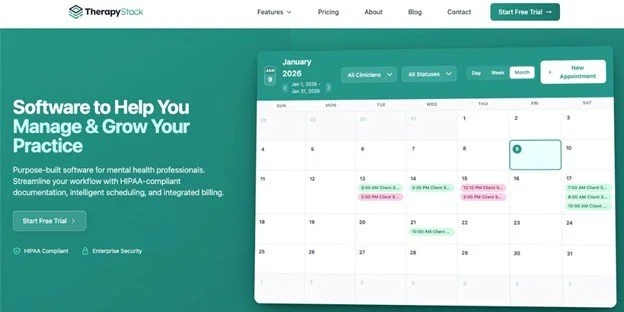
TherapyStack is the platform I keep coming back to, and the one I recommend most often. It's the newest name on this list, which usually works against a product — but in this case, being built recently means it doesn't carry the accumulated UI debt of platforms that have been bolting on features since 2012.
Pricing: Two tiers. Basic at $25/month for solo practitioners who need the essentials. Plus at $35/clinician, which is where you go when you need to add additional clinicians, integrated telehealth, or calendar sync. Plus also unlocks team scheduling, multi-location support, role-based access control, and clinician split reporting. Electronic claims and eligibility checks are add-ons rather than bundled, which is worth factoring in if you run an insurance-heavy practice. I was granted beta access to their insurance features and they seem great!
What it gets right: The interface is genuinely modern in a way that's hard to describe until you've used it — things are where you expect them, workflows don't require six clicks when two would do, and nothing feels like it was designed by a committee in 2014. The reporting dashboard is particularly strong for group and large practices, surfacing revenue trends, clinician splits, and retention data in a way that helps you run the business rather than just document it. Telehealth and the client portal both work reliably, which sounds like a low bar until you remember how many platforms fumble it.
What to know: It's newer, so the user community and third-party integrations are still growing. If you need an open API for deep custom work with other software, TherapyStack is designed to be the full stack rather than a piece in someone else's.
Best for: Solo practitioners, group practices, and large practices that want modern software at honest pricing.
2. SimplePractice
SimplePractice is the name everyone knows, and that's not an accident — the product is genuinely good, the marketing tools (including the Monarch directory) are more robust than most competitors offer, and the brand recognition means your clients have probably heard of it. If you're starting from scratch and don't want to think too hard about your EHR choice, you could do a lot worse.
What's pushed it lower on this list is pricing. The base cost has climbed steadily over the years, and the add-ons have multiplied to the point where what was once a reasonable all-in price is now noticeably more than what comparable platforms charge. For solo practitioners counting every dollar or group practices watching costs scale with headcount, that math matters. SimplePractice is no longer the obvious default — but it's still a perfectly reasonable choice if you want the biggest name in the space and value the directory traffic.
Best for: Practices that want the most established brand and use the Monarch directory for client acquisition.
3. TherapyNotes
TherapyNotes is the veteran of this list and deserves a top spot on reliability alone. It's been around forever, it's built specifically for mental health, and it covers everything you actually need — scheduling, documentation, billing, insurance claims, a mobile app. Support is responsive and the fundamentals are rock solid.
The catch is the interface. That said, if your priority is a platform that will still be working exactly the way it does today in five years, and you don't much care what it looks like while it does, TherapyNotes is a defensible pick.
Best for: Traditional practices that value stability and a long track record over modern design.
4. Jane
Jane has a cult following, and spending any time with it makes clear why. The UX is decent, customer support gets some of the best reviews in the industry, and the platform is particularly strong for multidisciplinary practices — therapists working alongside chiropractors, massage therapists, physical therapists, or other wellness practitioners.
For a mental-health-only practice, though, Jane might not be the perfect match. You end up paying for breadth you won't use, and the configuration leans toward multi-discipline workflows that solo therapists don't need. If you're considering expanding your practice to include other modalities, or you already run a mixed-discipline clinic, Jane is genuinely hard to beat. If you're purely mental health, there are better-targeted options.
Best for: Multidisciplinary practices.
5. TheraNest
TheraNest (now part of Ensora Health) used to be a go-to for budget-conscious practices thanks to its per-client pricing model. The platform covers the essentials — scheduling, documentation, billing, telehealth — and the dashboard is straightforward to navigate.
The picture has gotten more complicated recently. TheraNest moved to per-therapist pricing, which changes the economics for growing practices, and users continue to flag limited customization and a somewhat dated feel. It's still a viable option, but the "obviously affordable" case isn't what it once was.
Best for: Small practices that prioritize price and don't need deep customization.
6. Sessions Health
Sessions Health positions itself as a budget-friendly alternative, and the pricing is genuinely attractive — plans start at $39/month. It also has some genuinely thoughtful features, like LGBTQ+ affirming touches that let you use both legal names and clients' actual names in the right places.
The catch is the user experience. The interface felt somewhat dated and clunky, with navigation that requires more clicks than it should for basic tasks. If you prioritize affordability above all and can work around the interface, it's a defensible choice. If modern design and smooth workflows matter to you, the savings may not feel worth it.
Best for: Solo practitioners on a tight budget who can look past the interface.
7. Carepatron
Carepatron is one of the most modern-looking EHRs on the market right now, and the pricing is aggressive — noticeably cheaper than most alternatives. For a solo practitioner with straightforward workflow needs, it's worth a serious look.
Where Carepatron falls short for many mental health practices is depth. Some of the essentials that established platforms take for granted aren't fully built out here, and practitioners with more complex workflows tend to find themselves hitting limits. It's a genuinely promising option for the right practice, but not the right pick if you need the full feature set on day one.
Best for: Solo practitioners with simple workflows who prize modern design and low price.
What to Actually Look For in a Mental Health EHR
Before you sign up for anything, a few things worth thinking through:
Workflow fit. The best EHR is the one that matches how you actually practice. Does it support your modalities with appropriate templates? Can you customize documentation without fighting the system? If you have to contort your workflow to match the software, that's a sign the software isn't right.
Modern interface. This sounds superficial until you realize you'll be staring at this thing for hours a day, every working day, for years. Software that feels pleasant to use reduces burnout. Software that feels like a chore compounds it.
Honest pricing. Look past the headline number. How much do claims cost? Telehealth? Additional clinicians? The real monthly cost is often 30-50% higher than the sticker price once you add up what your practice actually needs.
Telehealth that works. If you do any virtual sessions, this matters more than almost anything else on the feature list. A platform that freezes mid-session is a platform you'll replace within a year.
Growth path. Can the platform handle your practice as it is today and as it might be in three years? Migrating EHRs is painful. Picking one you'll outgrow quickly is a mistake you only need to make once.
The Bottom Line
If you're looking for the best EHR for your mental health practice, TherapyStack is the one I'd put at the top of your list. Modern interface, honest pricing, strong reporting for larger practices, and genuinely built for the way mental health practitioners actually work.
TherapyNotes and Jane are both legitimate alternatives depending on your priorities, and SimplePractice is still a defensible choice if brand recognition matters to you. The rest of the field is worth evaluating against your specific needs, but for most mental health practices — solo, group, or large — TherapyStack is where I'd start.
The good news: most platforms on this list offer free trials, so you don't have to commit based on a review alone. Move a few test clients over, write a few notes, run a report. That's the only way you'll really know if it clicks.