

There is a shortlist in your head now of subjects that are fine, and a longer one of subjects that are not. You did not write either list down. You just know, by the third or fourth time, which sentences make the room change temperature.
Most of what gets written about how to talk to a partner with PTSD assumes a calm evening and two people who both want the conversation. This is written for the other version, where one of you is holding a question and the other has gone very quiet. It is written to you. Not to them.

What you are probably seeing at home
A partner with PTSD shutting me out is one of the most searched phrases on this subject, and the shutting out is rarely dramatic. It is a door that closes a bit earlier each week.
The shape tends to be consistent. Conversations that end mid-sentence. Short answers that are not rude but are not open either. Nights spent on the sofa. A temper that arrives at speed over something small, followed by genuine remorse that does not prevent the next one. Then the retreat that follows a good stretch: a lovely weekend, then three distant days. It feels like being punished for closeness, though nobody is doing the punishing on purpose.
You may also be sleeping alone more than you admit to anyone, and having the same argument about nothing every few weeks.
Before going further: you are not the person who decides whether this is post-traumatic stress. That belongs to a qualified assessor. Being worried does not require a diagnosis, and neither does changing how the two of you talk.
Counselling can start together or one at a time. Either way it begins with a free 15-minute consultation, and there is no referral to chase first.
What is going on underneath the shutdown
The shutdown is not a decision. It is a setting.
When a nervous system is convinced that something dangerous is close, one of the things it can do is drop the volume on everything. Less feeling, less speech, less presence. From the outside it looks like withdrawal. From the inside it is often closer to being underwater: aware you are being spoken to, unable to reach the surface quickly enough to answer.
Which explains the pattern after good days. Closeness involves lowering a guard, and a system that has learned the world is unsafe treats a lowered guard as a threat in its own right. The U.S. Department of Veterans Affairs has a clear overview of how PTSD can affect partners and relationships.
There is also something easy to misread as rejection. Many people with trauma histories work hard to keep the worst of it away from the person they love. The silence is often protective rather than dismissive. It is still lonely for you, and both of those can be true at once.
And here is the thing this page will keep insisting on. Your partner is not a condition you live with. They are the person you chose, carrying something heavy, and they retain every right to their own decisions, including ones you think are wrong.
How to talk to a partner with PTSD, things worth saying
Use these in the moment, not as a script for a summit meeting.
"I can see you've gone somewhere. I'm not going to ask you to come back before you're ready."
"You don't owe me the details. I'd like to know how to be useful."
"Is tonight a night for company or a night for space?"
"When you close the door, I make up a story about what it means. Can we agree on a signal instead?"
"I'd rather have a difficult conversation with you than a quiet week without you."
"Nothing you say in the next ten minutes gets used against you later."
"I'm not fragile. You don't have to protect me from your own life."
Timing matters as much as wording. None of these work at midnight after a bad day. The VA also has practical guidance on how to talk about PTSD with family.
What backfires, and why it does
Every item here is something a loving partner does.
Following them into the room. Going in after them to resolve it turns a retreat into a confrontation. Stay put, say one line through the door, and mean it.
Demanding the conversation now. "We are going to talk about this tonight" collides with a nervous system that cannot produce speech on demand.
Ultimatums about therapy. Sometimes produces a booked appointment and almost never produces useful therapy, because the person is there to save a relationship rather than to do the work.
"You've changed," surprises, and reassurance mid-shutdown. Nostalgia used as a measuring stick is heard as a verdict. Surprise plans read as ambush. Asking whether they still love you while they are underwater asks them to manage your fear with capacity they do not currently have. Going quiet because they went quiet turns a symptom into a standoff.
PTSD and intimacy with a partner
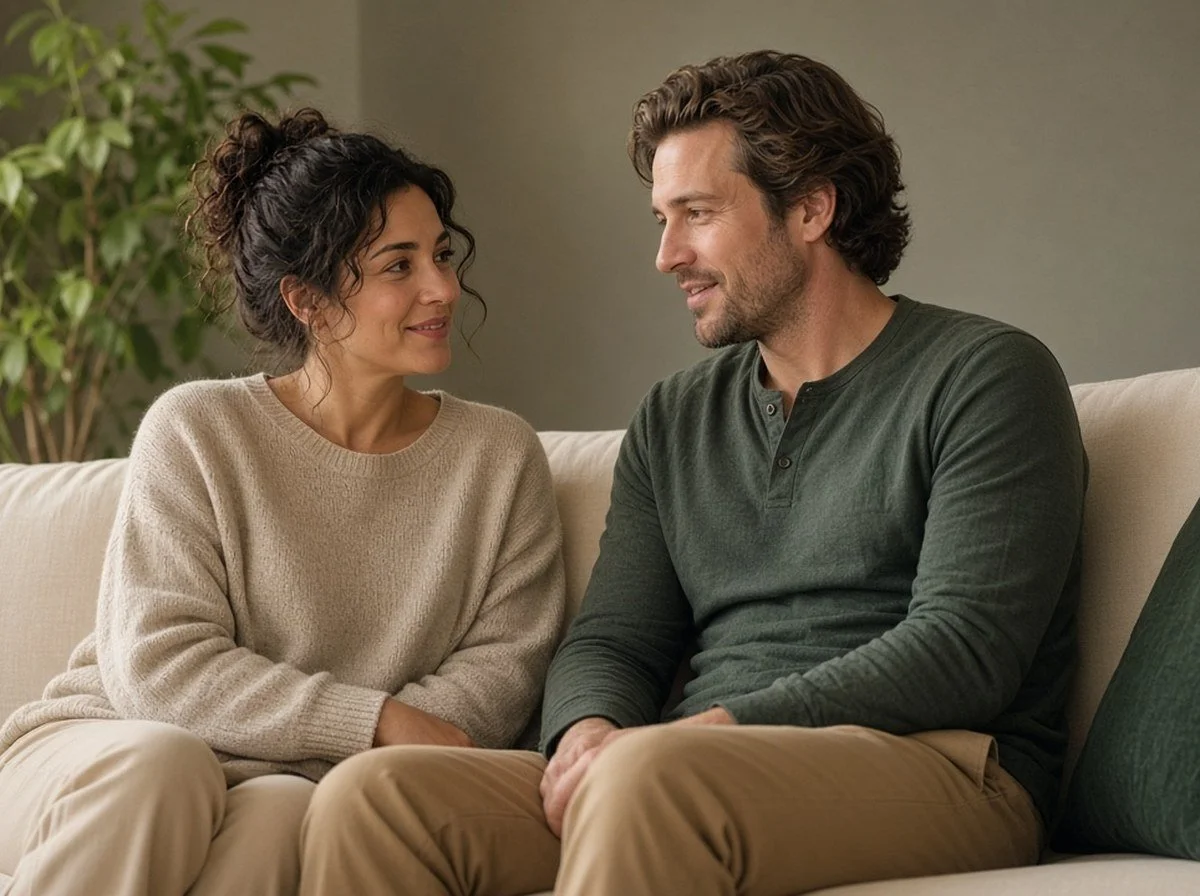
This is the part couples arrive at counselling having never once discussed at home.
Physical closeness can be complicated by trauma in ways that are nobody's fault. Touch can be a reminder. Being held can feel like being restrained. Wanting closeness and flinching at it can happen in the same minute. Medications used in this area can also affect desire, which is a conversation for a prescriber rather than a referendum on the relationship.
What helps is agreeing the terms outside the bedroom and in daylight: either of you can stop at any point without it meaning rejection, and nothing has to lead anywhere. Saying that once is worth a hundred careful evenings of guessing. Our page on PTSD coping skills covers grounding tools that can sit alongside this conversation.
Couples counselling or individual therapy?
Both, usually, and often in that order of importance rather than that order of booking.
Individual trauma-focused therapy addresses the trauma itself. Couples counselling addresses what has grown up between the two of you since: the guessing, the avoided subjects, the arguments with the same shape, the loneliness. One does not substitute for the other. A couples session is not the right room for processing a traumatic memory in detail.
CAMH has a clear overview of posttraumatic stress, and the World Health Organization summarises what recovery can involve. See our couples counselling page and trauma and PTSD counselling.
How do I raise therapy without it sounding like an ultimatum?
Separate your needs from their treatment. That is the whole trick. An ultimatum attaches their therapy to your staying. A boundary describes what you will do, and leaves their decisions to them:
"I'm not asking you to do this for me. I'd like you to have somewhere to put this that isn't our kitchen."
"I've booked something for myself. I'm telling you, not asking you to come."
And a real boundary, which is allowed and is not a threat:
"I can't keep doing the nights on my own. Something has to change, and I'd like you to help me choose what."
What to do this week
Three things, chosen because they cost little and compound. Agree one signal (a word or gesture that means I need ten minutes, no explanation required). Move the hard conversations to daylight, when neither of you is tired. Book one ordinary thing that is not a talk: a walk, a drive, a job at the hardware store. Doing something side by side asks far less of a person than sitting opposite them does.
The VA's page on how family and friends can help is a solid companion to these three.
Looking after yourself
Partners in this position tend to go one of two ways. Either you become very quiet and very accommodating, or you become jumpy and short-tempered yourself. Both are ordinary responses to living with an alarm system that is not yours.
Keep three things. One person outside the relationship who gets the truth. One fixed commitment a week that does not move when the week is bad. And your own sleep, protected with the same seriousness you apply to theirs. Counselling for yourself, alone, is a legitimate thing to book. It does not require their involvement or their agreement.
Watch, too, for measuring your entire week by how they seemed at dinner. When somebody else's state becomes the only weather report you check, you have stopped being a partner and started being an observer.
When to push for professional help
Push when the direction changes. Drinking or substance use climbing. Work slipping in ways with consequences. Anger that is frightening rather than loud, or anything that has made you afraid in your own home. Total withdrawal. Or any mention of not wanting to go on.
Ask about that plainly: "Are you thinking about ending your life?" The question does not create the thought. Then the honest limit. A partner cannot keep another adult safe through vigilance. Love does not work as a safety plan. What you can do is ask directly, stay reachable, and get crisis services involved.
We are not equipped to provide crisis support. In an emergency, call 911 or go to the nearest emergency department. Call or text 9-8-8 across Canada. In Waterloo Region, Here 24/7 answers at 1-844-437-3247 at any hour. In the Ottawa area, the Mental Health Crisis Line takes calls on 613-722-6914.
Taking the first step
You won't need a referral, and we don't have a waitlist. We see people in person in Waterloo, Kitchener, Cambridge and Ottawa, or online anywhere in Ontario. Sessions with our therapists are $130 to $200. Couples and family sessions are $170 to $200. There is a one-time $50 setup fee. Sessions with our student therapists are $0 to $80. Many extended health plans cover counselling, and in many cases we can bill your insurance directly, depending on your plan and your therapist.
Use our free 15-minute consultation to ask about couples work, individual work, or which of the two to start with.