
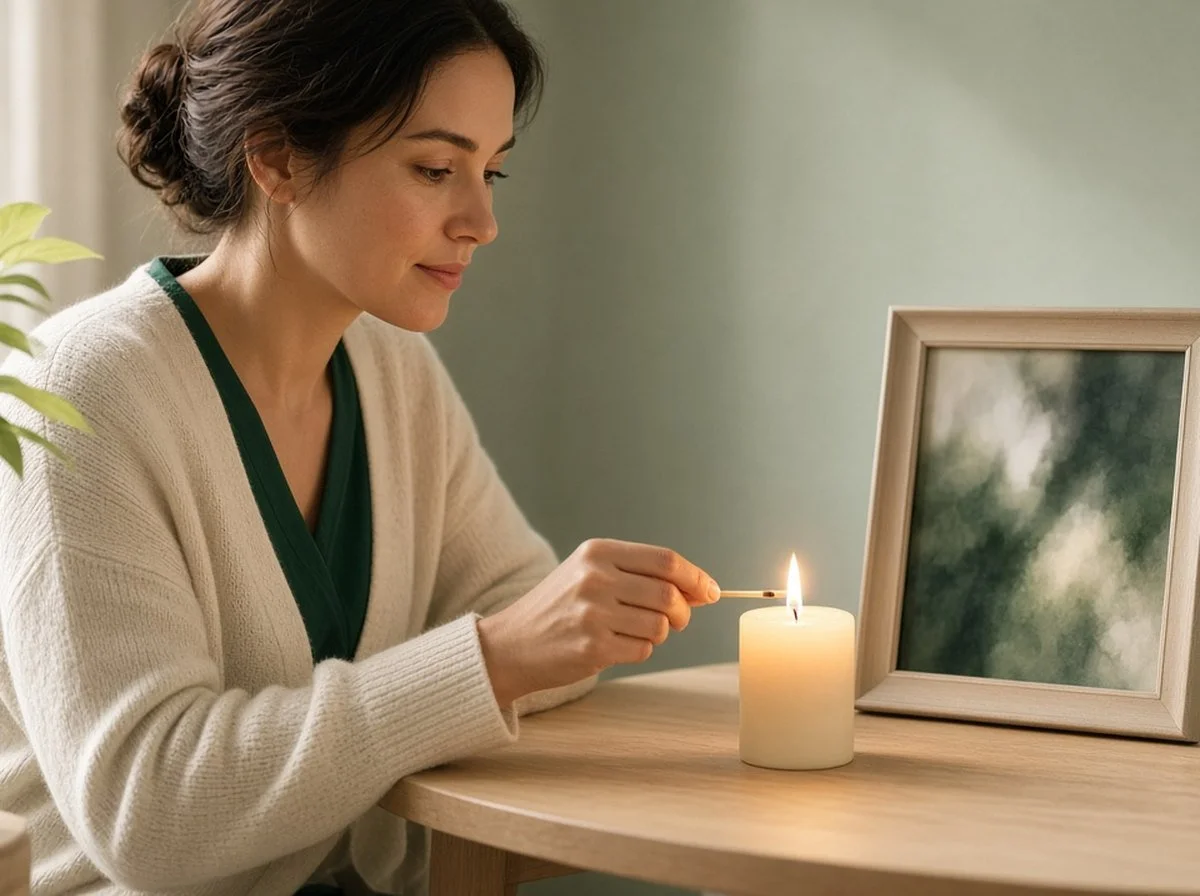
The calendar keeps moving toward gatherings that used to feel automatic. A song, a smell, an empty chair, and the loss is suddenly loud again. If you are dreading the holidays because someone is missing, you are not doing grief wrong. You are grieving in a season that insists on cheer, photos, music and busy holiday plans.
This page is for you, the person carrying the loss. It offers gentle ways to plan the hard days ahead, keep or change traditions, and remember someone you love without forcing anyone into cheer. It is not a script for fixing other people's grief. Canadian Thanksgiving, winter holidays and New Year can all reopen the wound in their own different ways.
Why the holidays can make grief louder
Holidays are built from memory. The same table, the same foods, the same jokes. When someone is gone, every familiar cue points at the absence. Other people may expect you to be "festive," which can make the gap feel even wider.
Grief also does not follow a neat calendar. CMHA's Mental Health for Life guide talks about making time for important people and building supports that fit your life, which still matters a great deal when grief has rearranged everything. MedlinePlus describes bereavement as the period of grief and mourning after a loss, and notes that people experience it in their own different ways. Some days are manageable. Holiday dates often are not among the easy ones for most grieving people.
You may feel sad, numb, angry, guilty for laughing, or exhausted by small talk. All of that can belong to grief.
The body keeps score too. Tight chest, no appetite, too much appetite, or sleep that will not settle are common. Treat those signals as part of mourning, not as a separate failure.
The first holidays after a loss
The first round of holidays after a death is often the hardest, because every "first" is a new proof that the world kept going. You do not have to make the day meaningful in a big way. Surviving it with a little practical kindness toward yourself is enough.
Give yourself permission to do less. A shorter visit. A quieter meal. A day alone with one candle and a walk. Skipping a tradition is allowed. So is keeping one small piece of it.
Tell one trusted person what you need before the day arrives. People often want to help and do not know how. A clear ask saves them guessing and saves you explaining through tears.
If depression and grief feel hard to tell apart, our guide on grief vs depression can help you sort the language. Only a professional can assess what fits.
Plan the hard days ahead of time
A simple plan reduces the number of decisions you have to make while crying in a bathroom.
Decide how long you will stay, or whether you will host at all.
Choose one support person who knows the exit word.
Arrange your own ride home if you can.
Pack an exit: a walk, a quiet room, a call to a friend.
Decide in advance what you will say when someone asks how you are.
You can change the plan on the day. Having one still helps, because decision-making is harder when grief is loud. NIMH's caring for your mental health page reminds readers that small acts of self-care and staying connected to supportive people can help under stress.

Keep, change or pause traditions
Traditions are tools, not laws. Ask three questions about each one.
Does this bring comfort?
Does this hurt more than it helps right now?
Can it be smaller, later or different?
Some families keep the recipe and change the seating. Some open one gift in the person's honour and skip the rest. Some start a new walk on the morning of the holiday. There is no correct choice, only the one that fits this year. Next year you can choose again.
Our post on the stages of grief explains why grief rarely moves in a straight line. Expect waves, not a checklist.
Ways to include the person who died
Inclusion can be quiet. A photo on the table. A favourite song. A toast. A donation. A plate set briefly, then put away. Writing a letter you never send. Cooking their dish and sharing stories with people who knew them.
You can also include them privately, with no audience. Both count equally. You do not owe anyone a public performance of mourning.
If children are part of the day, give them simple language. "We miss them, and we can still celebrate in a smaller way." Kids usually handle honesty better than forced cheer.
When family grieves differently than you
People in the same family can need opposite things. One person wants stories. Another needs silence. One wants the usual party. Another cannot walk into the room. Conflict often comes from mismatched pace, not from lack of love.
Try naming your need without attacking theirs. "I'm going to step out during dessert" is clearer than "You never understand." Let others have their way of remembering, and ask for room for yours.
You can leave early. You can decline an invitation. You can attend for one hour. Grief does not require you to protect everyone else's comfort before your own.
If gifts are part of the season and you are supporting someone else who is grieving, our grief gift ideas for 2026 post has practical ideas. This page stays with your own grief.
Taking care of your body and sleep, gently
Grief is physical. Appetite changes. Sleep frays. Energy drops. Keep the basics as kind as you can: water, simple food, a regular bedtime when possible, a little daylight and movement. Skip the pressure to optimize. Gentle is enough.
Alcohol can numb the evening and roughen the morning. Notice what it does for you, and decide on purpose rather than by default.
If sleep is wrecked, keep the room dark and cool, and avoid making the night a second work shift of rumination. A short walk earlier in the day sometimes helps more than forcing rest at midnight.
A note for the days after the holiday
The day after can surprise you. You may feel relief that it is over, then a fresh wave when the house is quiet. Plan a soft landing: leftovers, a show you like, loose clothes, and a short check-in with someone who gets it. Do not schedule hard family conversations for the morning after unless you truly want them.
Write one note to next year's self while the memory is fresh. "Leave by 7." "Skip the big party." "Keep the photo on the table." Future-you will thank present-you for taking time to write that short note.
When grief support can help
Counselling can help when grief stays overwhelming, when daily life will not restart, when guilt or anger is stuck, or when the holidays keep knocking you down year after year. You do not have to be in crisis, or in the first year of loss, to deserve a steady and private place to talk. Our grief counselling page explains how we work.
A free 15-minute consultation lets you describe what this season is like, with no commitment. Individual sessions with our therapists are $130 to $200, and there is a one-time $50 setup fee for new clients, which is not charged for the free consultation. Depending on your plan, your insurance may cover the full session fee. We offer online sessions across Ontario, and offices in Waterloo, Kitchener, Cambridge and Ottawa.
If grief brings thoughts of suicide, call or text 9-8-8 any time. In Waterloo Region, Here 24/7 is 1-844-437-3247. If you are in immediate danger, call 911.