
Defense mechanisms are automatic, mostly unconscious ways the mind protects us from painful feelings like anxiety, shame or grief. Everyone uses them. They are not a diagnosis or a flaw.
This article explains why the mind uses them, everyday examples of common ones, how they can help or get in the way, and how counselling can help you notice your own patterns.
What are defense mechanisms?
The APA Dictionary of Psychology describes a defense mechanism as an unconscious reaction pattern the mind uses to protect itself from anxiety that comes from inner conflict. In later theories, defenses are also seen as ordinary ways of coping with everyday problems and outside threats.
The idea began in psychoanalysis with Sigmund Freud. Later researchers, including Phebe Cramer in 2000, studied defenses as real patterns that still matter in everyday life. You do not need to be in therapy to use them. You already do. In Canada, you may also see the spelling “defence mechanisms.” It means the same thing. The name can sound formal. The experience is ordinary. Your mind is trying to keep you from being flooded.
Why the mind uses them
Defenses buy time. They protect self-esteem when a feeling is too sharp to take in all at once. A little denial can help you get through a hard afternoon. Humour can take the edge off a painful truth. Trouble starts when one pattern is used rigidly, and it blocks problem solving or closeness.
A defense is usually automatic. Coping skills are more deliberate things you can practise, such as naming a feeling or taking a short pause before you reply. Both can be useful. The difference is how much choice you have in the moment. When a defense is the only move you have, life can start to feel smaller than it needs to be.

Common defense mechanisms, with everyday examples
These are everyday examples, not labels to put on other people.
Denial: you keep working as if a breakup did not happen, even though the evidence is in front of you.
Projection: you are angry, but you become sure the other person is the angry one.
Displacement: you had a rough meeting, then snap at someone who feels safer to snap at, like a partner or a roommate.
Rationalization: you tell yourself you did not want the job anyway, after you did not get it.
Intellectualization: you can explain a loss in careful, logical words, but you do not let yourself feel it yet.
Repression: a painful feeling or memory stays out of reach, so you cannot quite name what is bothering you.
Reaction formation: you feel envy, then go out of your way to be extra kind and approving.
Regression: under stress, you return to an earlier way of coping, like shutting down or wanting someone else to take over.
Humour: you make a wry joke that tells the truth and also makes the moment bearable.
Sublimation: you put a hard feeling into something useful, like a long run or a careful piece of work.
You may recognize more than one. That is normal. A single moment does not define you. It can even be a relief to have a name for a reaction you have felt embarrassed about. A name is a starting point for curiosity, not a verdict on your character.
Healthy vs less helpful defense mechanisms
The APA Dictionary notes that defenses range from more mature to less mature, depending on how much they twist reality. Denial sits at the less helpful end, because it pushes reality away. Sublimation is often seen as more mature, because it lets a real wish find a safer outlet.
George Vaillant, writing in 1994, argued that looking at a person’s defensive style helps us see what is adaptive as well as what is unhelpful. He also wrote about less mature defenses in clinical work. The useful question is not “do I have defenses?” It is “is this one still protecting me, or is it running my life?” A defense that helped you in a difficult season can become a habit. Habits can be updated. You do not have to rip this one out. You can learn to notice it sooner, and then choose a second option.
Defense mechanisms in relationships
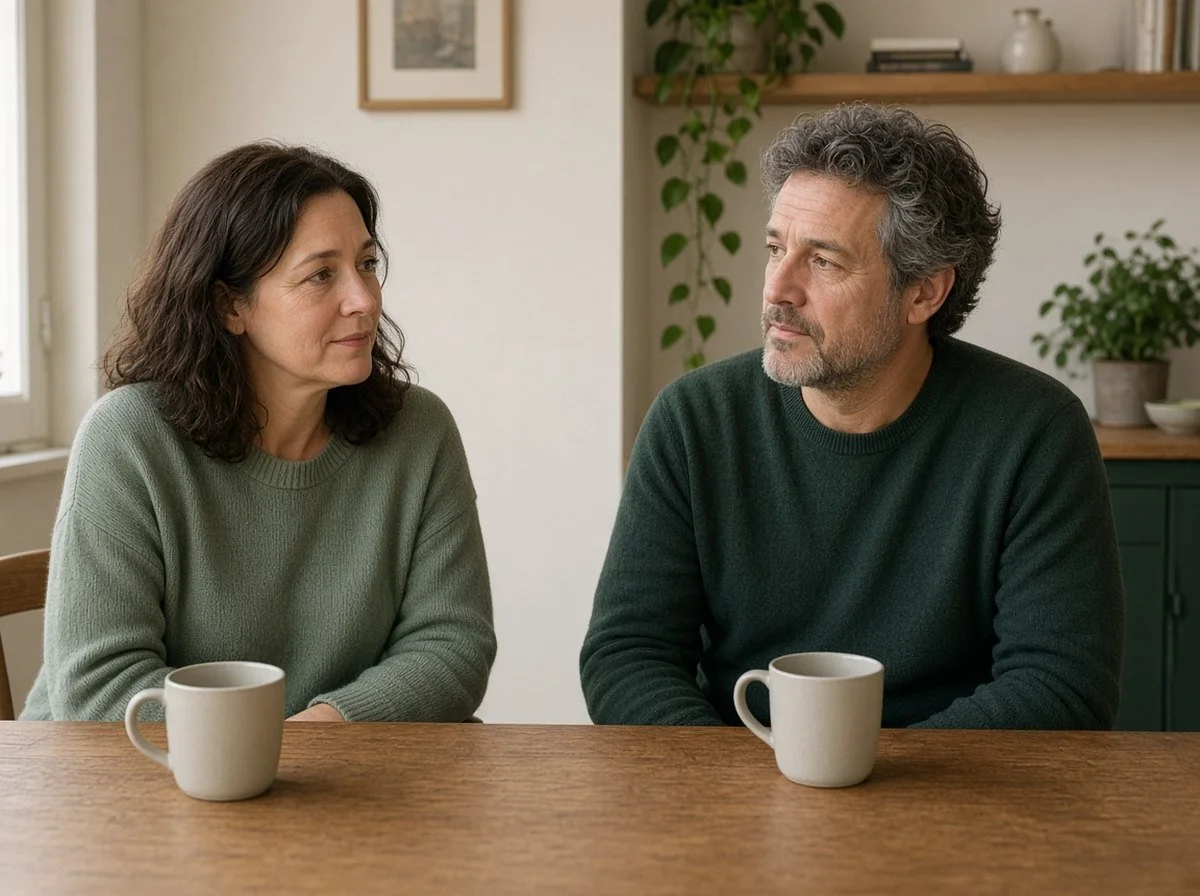
Defenses can collide in an argument. One partner explains everything in careful, logical words. The other withdraws. Each move protects someone, and each can leave the other feeling alone. Over time, the same loop can start to feel like the whole relationship, even when care is still there underneath.
It can be tempting to diagnose a partner. Try not to. Naming their pattern for them, especially in the middle of a fight, usually shuts the conversation down. You can talk about what you felt and what you needed, without turning their reaction into a diagnosis. That shift keeps the focus on the relationship, not on winning an argument about who is right in the heat of the moment. It is more useful to notice what happens between you. If you tend to leave when things get tense, our post on why you might push people away may be useful. If you change the subject or go quiet to keep the peace, see our post on conflict avoidance in relationships.
How to notice your own defense mechanisms
Curiosity works better than blame. You are not looking for a flaw. You are looking for a pattern that once had a job. You might ask yourself:
What do I usually do right after stress hits?
What feeling was in the room just before I explained, joked, left or got busy?
Does this pattern help me get through the moment, and does it cost me later?
These are reflective questions, not a test. A pattern that shows up only once in a while may be doing its job. A pattern that shows up every time closeness or criticism appears may be worth a closer look. If you find yourself getting harsh about what you notice, our post on self-compassion can help you stay kind while you look.
If you are thinking about suicide or hurting yourself, call or text 9-8-8 now. If you or someone else is in immediate danger, call 911.
How counselling can help
Psychodynamic therapy explores these patterns directly. Internal family systems therapy looks at protective parts of you that learned to step in. Both are approaches we offer, and a counsellor can help you notice a defense without shaming it, then practise a more flexible response. Therapy is not about catching you out. It is about making more room between the feeling and the automatic move, so you have a little more choice.
People often arrive in counselling feeling embarrassed about a pattern they cannot seem to drop. That reaction makes sense, and it does not have to be the end of the story. We offer counselling at our Kitchener-Waterloo, Cambridge and Ottawa offices and online across Ontario.
Your next step
If you keep seeing the same pattern and want to understand what it protects, you can book a free 15-minute consultation with our admin team. It is a chance to ask questions and see whether counselling is a good fit. Booking it does not commit you to ongoing sessions. The call is not a therapy session or a crisis service.
If you or someone you love is in immediate danger, call 911. If you are thinking about suicide, call or text 9-8-8, any time.
Last reviewed: November 2026
Sources
American Psychological Association. APA Dictionary of Psychology: defense mechanism.
American Psychological Association. APA Dictionary of Psychology: projection.
Vaillant GE. Ego mechanisms of defense and personality psychopathology.
Cramer P. Defense mechanisms in psychology today: further processes for adaptation.