
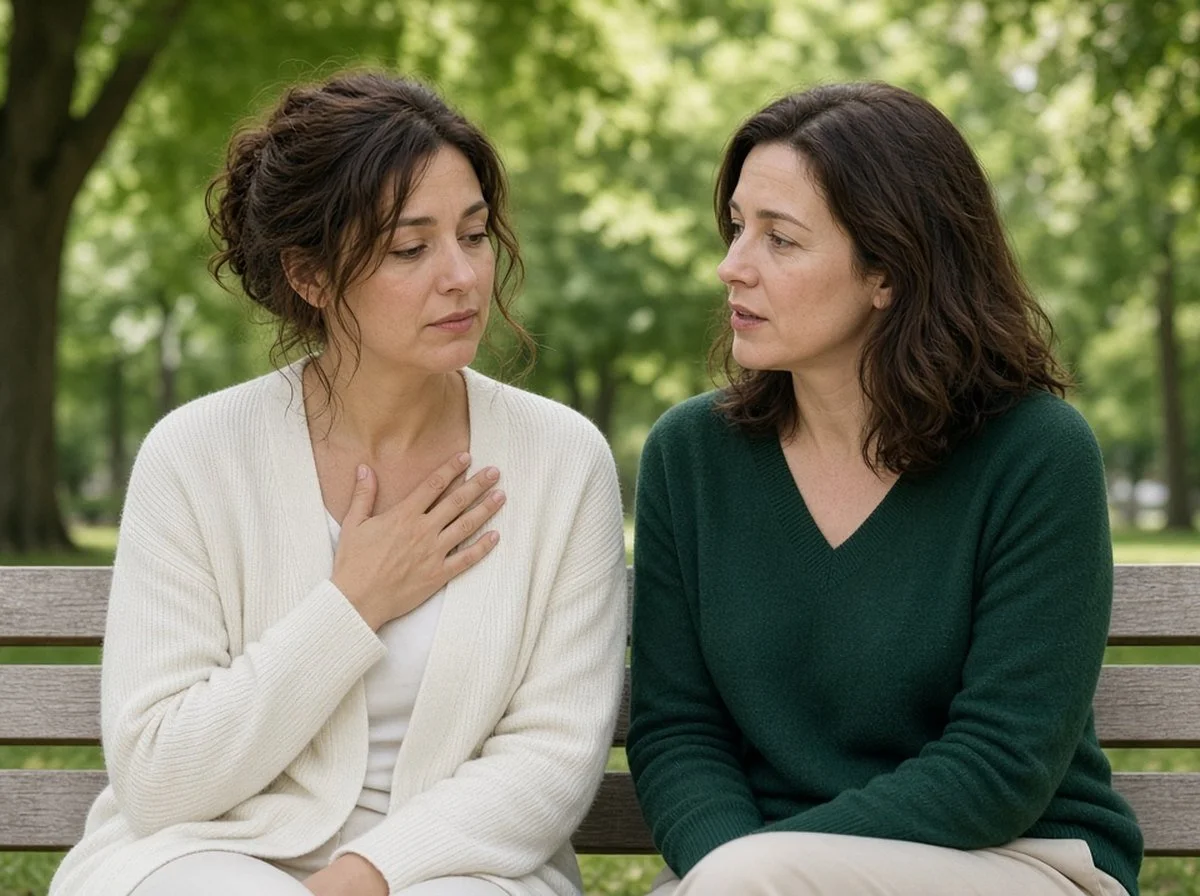
If you have chest pain right now that is new, severe or different from your usual pattern, or it comes with shortness of breath, sweating, nausea, fainting, or pain spreading to your arm, jaw, neck or back, call 911 or go to the nearest emergency department now. Chest pain with those symptoms means 911 or the emergency department. Don't drive yourself, and come back to this article afterward.
Here's the short version. Heart-related chest pain tends to feel like pressure that builds when you exert yourself and eases when you stop. Anxiety chest pain tends to be sharper, more local, and often shows up while you're sitting still. But these are tendencies, not a test. They can help you make sense of a pattern you've had for months. They can't rule out a heart problem in a single episode, because that takes a heart tracing and blood tests, not a description.
The one-line difference with anxiety chest pain
Heart pain is usually a supply problem, so it tends to show up when demand goes up. Stairs, a hill, a heavy bag, shovelling the end of the driveway. Stop and it often settles.
Anxiety chest pain is an alarm problem. Your nervous system fires a surge that tightens the muscles across your chest, speeds up your breathing into the top of your lungs and floods you with adrenaline. None of that needs you to be doing anything, which is why it so often arrives in bed, in a grocery store lineup, or in the minutes after something stressful has already ended.
That last part catches people out. The surge often lands after the stressful moment, not during it, so the timing doesn't point at stress. You're left with a chest that hurts for no reason you can name.
Once your heart has been checked and you're still living with the sensation, a free 15-minute consultation is a good next step.
Where anxiety pain and heart pain overlap
Far more than anyone would like.
Both can hurt in the middle of the chest. Both can come with breathlessness, sweating, nausea and a racing pulse. Both can wake you from sleep. Both can bring a strong sense that you might be about to die. In panic, that feeling is a common symptom, not a forecast.
Here's the overlap that matters most, and it's why this article won't tell you which one you have. Anxiety doesn't protect you from a heart problem. You can have panic attacks and a heart condition at the same time, and a long history of panic is not a reason to talk yourself out of a new or different episode.
Two more cautions. Heart symptoms can look different in some people. Women, older adults and people with diabetes are more likely to have symptoms without the classic crushing pressure, like unusual tiredness, nausea, breathlessness, or discomfort in the jaw, neck or back. And chest pain has other causes too, like muscle strain, reflux or inflammation, which is another reason a proper medical check beats guessing.
Where they tend to differ
Read this as a set of leanings, not a scoring sheet. Every row has exceptions, and real episodes often borrow from both columns.
How it feels. Anxiety: sharp, stabbing, or a tight band, sometimes in a spot you can cover with a fingertip. Heart: pressure, heaviness, squeezing or a weight, hard to point to with one finger.
What sets it off. Anxiety: often nothing obvious, at rest or after a stressful moment. Heart: often exertion, like stairs, hills or shovelling snow.
What comes with it. Anxiety: tingling in the hands or around the mouth, light-headedness, a sense that things aren't real, a strong fear of dying. Heart: sweating, nausea, breathlessness, discomfort spreading to the jaw, neck, arm or back, feeling faint.
The shape over time. Anxiety: climbs fast, peaks, then fades, sometimes leaving a sore chest for hours. Heart: may keep going rather than peak and pass.
Pressing on the spot. Anxiety: pressing sometimes brings back the ache, which points to the chest wall. Even so, this doesn't rule out a heart problem.
What does anxiety chest pain feel like?
Many people describe one of three things. A tight band, as if a strap has been cinched around the lower ribs. A sharp catch on one side, worse on a deep breath. Or a dull, bruised soreness that lingers after a panic attack has passed.
Alongside it there's often fast, shallow, high breathing you may not notice. That's what causes tingling fingers and pins and needles around the mouth, symptoms that are common in panic.
What happens at the emergency department
Much of the fear about going is fear of the unknown, or of being a nuisance. You're not a nuisance. Chest pain is exactly what emergency departments are set up to sort out.
Chest pain is treated as a priority. A heart tracing, called an electrocardiogram or ECG, usually happens early and takes a few minutes. Blood tests follow, and they're often repeated after a few hours to see whether anything is changing. That's why chest pain visits can take a while, and why leaving early undoes much of the value of going. Depending on the results, there may be more tests before you go home.
Call 911 rather than driving yourself or being driven. Paramedics can start checking your heart and begin treatment on the way.
A few details help, and they're easier to gather now than at 3 a.m.:
when it started, and what you were doing
where it sits, and whether it spreads anywhere
what makes it better or worse
any heart problems in your close family
everything you take, prescription or not
whether you've had episodes like this before, and what testing showed
Why does it come back after normal tests?
Because a normal result describes your heart, and the thing that hurts is still happening. Three things usually keep it going.
Reassurance wears off. A clear test brings relief, then doubt creeps back, often around the thought that something was missed.
Checking. Taking your pulse, pressing on your chest and testing whether it still hurts keep your attention parked on the exact spot you fear, and attention makes sensations louder.
Avoidance. After a scare, many people stop exerting themselves. Being less active can make your heart race at lower effort, which brings back the very sensations that frightened you.
None of this is imaginary. The pain is real, the muscles really are tight, and your breathing really has changed. What a normal test tells you is which system is generating it, and that system can be worked on.
When counselling helps
Counselling isn't a substitute for a medical check, and it can't rule out a heart problem. If your chest pain has never been checked medically, get it checked. Any new, severe or different chest pain goes to 911 or the emergency department.
Once your heart has been checked, the second problem is worth naming. Not the pain itself, but the bracing. Checking your pulse before you get out of bed. Avoiding hills. Carrying your phone into the shower. That pattern responds to therapy, usually by cutting back the checking and slowly rebuilding what you've stopped doing. Our anxiety counselling page explains how we approach it.
One small skill helps too. Fast, shallow breathing creates much of the tingling and tightness, so the lever is the out-breath. Breathe out longer than you breathe in, with your belly moving rather than your shoulders. It won't switch off a panic attack on demand, but it can stop you adding to one. Our guide on how to stop a panic attack has more.
If the fear of dying has become its own problem, our article on death anxiety may help.
If the fear has grown big enough that you've thought about not being here, please reach out tonight. Our practice can't offer crisis support. Call or text 9-8-8 any time. In Waterloo Region, call Here 24/7 at 1-844-437-3247. In Ottawa, call the Mental Health Crisis Line at 613-722-6914.
Taking the first step
You won't need a referral, and we don't have a waitlist. We see people in person in Waterloo, Kitchener, Cambridge and Ottawa, or online anywhere in Ontario. Sessions with our therapists are $130 to $200, and there is a one-time $50 setup fee. Many extended health plans cover counselling, and in many cases we can bill your insurance directly, depending on your plan and your therapist. Depending on your plan, your insurance may cover the full session fee.
Been cleared and still bracing for the next one? A free 15-minute consultation can show you what working on that part would involve.