
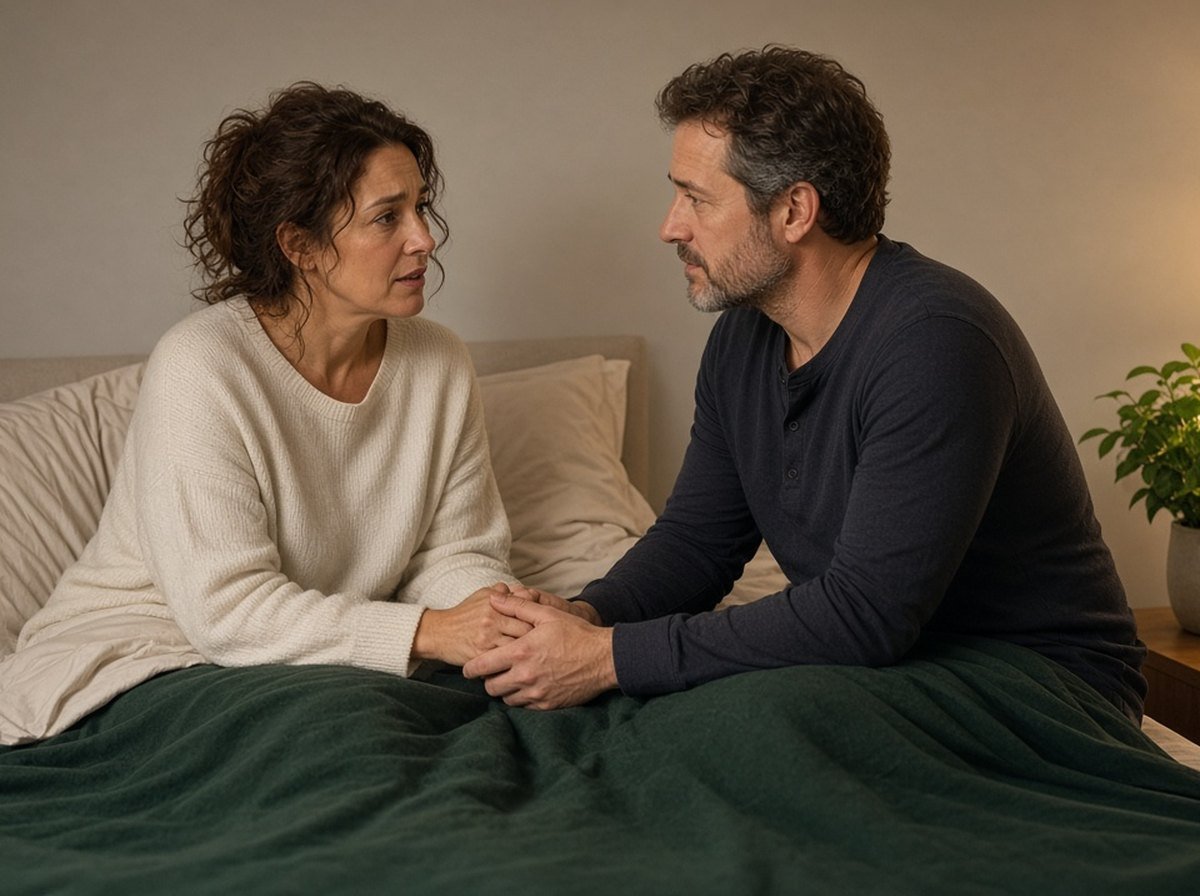
It's 3:12 a.m. and nothing woke you. But now you're wide awake, heart thumping, thinking about dying, or about someone you love dying, and the thought won't let go.
If this keeps happening, you may be dealing with death anxiety. This article explains why it hits hardest in the middle of the night, what death anxiety is, how it differs from suicidal thinking, and what actually helps, both at 3 a.m. and in daylight.
Why does death anxiety hit hardest at night?
Because at that hour, you have none of the things that normally hold the fear at arm's length. No daylight, no tasks, nobody to talk to, and a brain surfacing from light sleep with its guard down.
Daytime is full of interruptions that stop a thought from finishing. At 3 a.m. the thought gets a clear run.
There's a physical side too. The second half of the night has more dreaming sleep, and brief wake-ups from it are normal. On the nights you remember, you come up already alert and emotional, without the slow start an alarm clock gives you. On top of that, the body's alertness hormones start rising in the early morning hours, which is why an early wake-up can feel charged rather than drowsy.
Fear of death at 3 a.m. usually isn't a tidy philosophical question. It's a physical drop, a racing heart, and a feeling that you've understood something terrible that you'll lose the thread of by breakfast. Which you will, and that's part of why it comes back.
If your nights have been going like this for months, you don't have to figure out why on your own. A free 15-minute consultation is a low-pressure place to begin.
What is death anxiety?
Death anxiety is a fear of dying, of being dead, or of the people you love dying, strong enough that it gets in the way of ordinary life. The word people find online is thanatophobia, from the Greek word for death.
Thanatophobia isn't its own diagnosis in the DSM-5, the manual clinicians use. Instead, fear of death runs through other kinds of anxiety. It can show up during panic attacks, where the fear is specifically of dying. It can attach to a body symptom in health anxiety. It can be one worry among many in generalized anxiety. And it can show up on its own, often after something happened. Researchers describe it as a fear that cuts across many anxiety problems.
It also helps to know that death anxiety is often three different fears wearing one coat:
Fear of the process. Pain, losing control, hospitals. This is often sharpest in people who have watched someone die.
Fear of the ending. Not being here. The blank. This is the version that shows up at 3 a.m.
Fear for the people left behind. Who will manage, and what happens to your kids. Parents of young children often feel this one hard.
In daylight, it shows up in smaller ways, like reading about the plane after booking a flight, or checking on a sleeping child more often than you'd admit. From the outside, none of this looks like a fear of death, which is why people carry it for years without naming it.
Is thinking about death this much a warning sign?
Not on its own. Thinking about death a lot isn't the same as wanting to die, and it's worth saying plainly, because many people are afraid to mention any of this in case it's heard as the other thing.
Death anxiety is a fear of the ending. It wants more time, not less. The feeling underneath it is dread. Suicidal thinking usually runs the other way. The feeling underneath is exhaustion, and the pull is toward relief from pain. People can have both, which is confusing, but they aren't the same and they need different responses.
If you're having thoughts of ending your life, even faintly, please tell someone today. Our practice can't offer crisis support. Call or text 9-8-8 any time. In Waterloo Region, call Here 24/7 at 1-844-437-3247. In Ottawa, call the Mental Health Crisis Line at 613-722-6914. If the risk feels immediate, call 911 or go to the nearest emergency department.
Sudden intrusive images of your own death, or someone else's, are also very common. They say nothing about what you want. They're usually the mind running a threat drill.
Does belief or religion change death anxiety?
Less predictably than people expect. Some people find real steadiness in their faith. For others, a belief sharpens the fear. People who have left a faith sometimes carry dread plus guilt about the dread. And plenty of non-religious people are at peace with the whole thing.
Research on this is mixed. Some studies suggest that people who are very religious and people who are firmly non-religious may both report less fear than people somewhere in between. What seems to matter is how settled you feel in what you believe, whichever way you landed.
If faith is part of your life, it's fair to ask a therapist how they work with that. Nobody here will argue you out of a belief or into one. The work is about the fear.

When death anxiety is really about control
Death anxiety rarely arrives out of nowhere. It often starts in a particular season: a diagnosis in the family, a parent getting frail, a baby being born, a job ending, a health scare, or turning an age that feels meaningful. Something has taken control away, and death is the biggest uncontrollable thing there is, so the feeling collects there.
It can also surface once a crisis is over. People who handled a parent's last months calmly may fall apart months after the funeral. Nothing has gone wrong. There's finally room to feel it.
The clue is the date. If you can name roughly when it started, the fear may be carrying something for you. If it began the month your mother's scan came back, therapy may focus more on your mother, and what you've been holding, than on mortality itself.
What helps with death anxiety at night
Start with things that make the nights easier, then do the deeper work in daylight.
Get out of bed. Lying in the dark arguing with a fear gives it the whole field. Spend about 20 minutes in another room with low light and something dull, then go back to bed.
Stop looking for the answer at 3 a.m. Write the thought down on paper and agree to look at it on Saturday morning. Many thoughts don't survive daylight.
Don't make decisions at night. The fear may push you to cancel a flight or rewrite your will at 4 a.m. Any decision it suggests gets made in the afternoon, with someone else in the room, or not at all.
Notice the reassurance loop. Googling symptoms, checking your pulse, asking if you look okay. Each check buys a little relief and makes the next one more likely. Cutting back is uncomfortable at first, then the fear starts losing its fuel.
Give the fear a set time. Trying not to think about death rarely works. A planned 15 minutes a day, sitting with the thought on purpose, can loosen its hold on the rest of the day.
Spend your days on what you're afraid of losing. A smaller life makes the nights worse, not better.
How counselling helps with death anxiety
Therapy usually runs on two tracks. One is learning to let an uncertain thought be there without wrestling it, which is close to acceptance and commitment therapy (ACT). The other is cutting back on the checking and avoiding, which is standard cognitive behavioural work. If a death started this, grief work often sits underneath both. None of it removes the fact of mortality, and anyone promising you total peace in six sessions is overselling.
Some people with severe night-time anxiety also ask about medication. Our Nurse Practitioners, who see clients in Kitchener, Waterloo and Cambridge, can assess and diagnose anxiety and prescribe medication when it's needed. Our therapists provide the counselling. Plenty of people do both, and plenty do neither.
It's worth getting support when your nights are costing you your days, when you've started avoiding hospitals, funerals or medical appointments, or when someone close to you has mentioned it more than once. If the fear comes with panic attacks, our guide on how to stop a panic attack may help too.
We see people in person in Waterloo, Kitchener, Cambridge and Ottawa, or online anywhere in Ontario. Sessions with our therapists are $130 to $200, and there is a one-time $50 setup fee. Many extended health plans cover counselling, and in many cases we can bill your insurance directly, depending on your plan and your therapist. Depending on your plan, your insurance may cover the full session fee. You won't need a referral, and we don't have a waitlist.
Taking the first step
When you'd rather talk to a person than another search box, book a free 15-minute consultation. Nothing has to be decided at the end of it.