
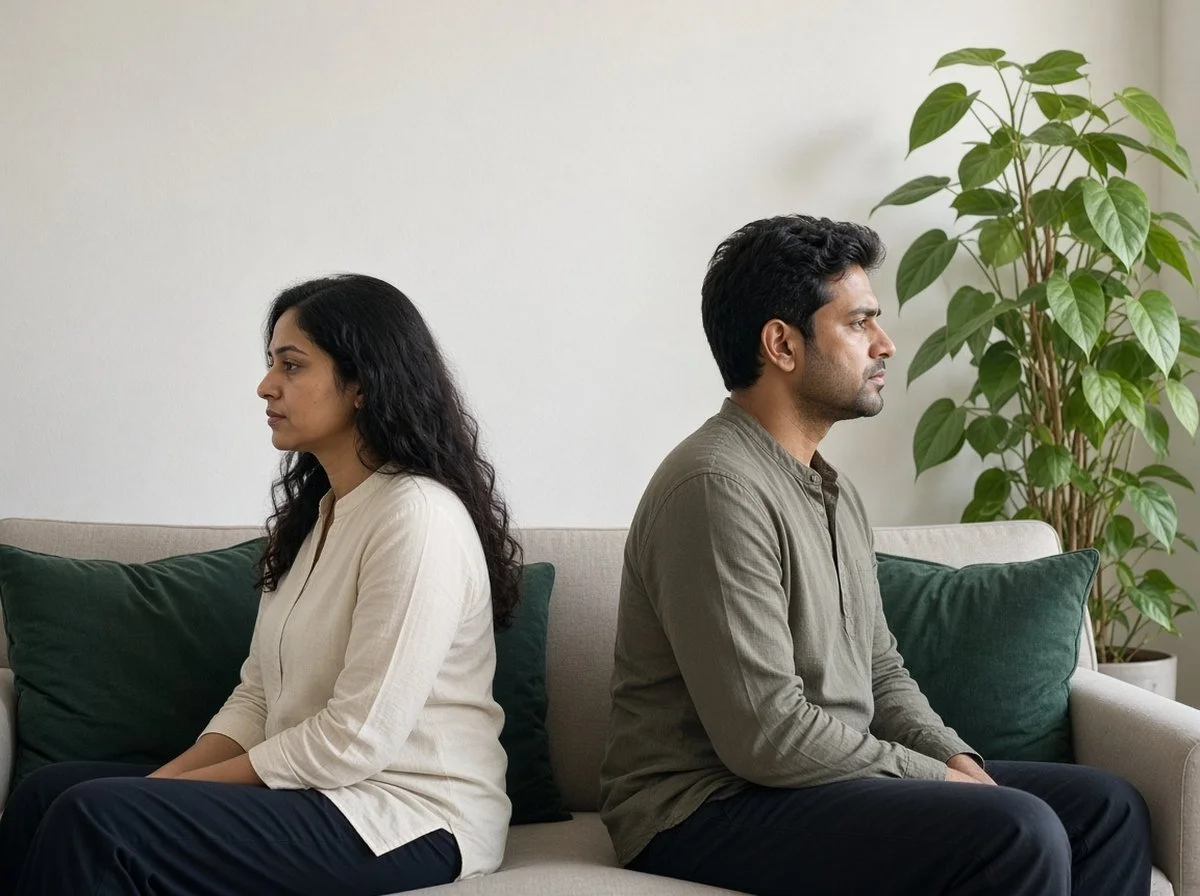
Maybe it crept up slowly. You used to look forward to seeing your partner, and now you feel flat when they walk in. You get along, but it feels more like roommates than a couple. If you think you are falling out of love, you might feel guilty, confused or scared about what it means. This post looks at the signs, how love changes over time, why feelings fade, whether love can come back and how counselling can help you sort out what you want.
This post is general information, not a diagnosis or a treatment plan.
Signs you are falling out of love, or think you might be
Falling out of love rarely happens all at once. It is more often a slow drift. Here are some signs people describe:
You feel flat or numb around your partner, rather than warm.
It feels like you are roommates who share a calendar.
Small habits that used to be cute now irritate you.
You do not miss them when they are away.
You daydream about a different life, with or without someone else.
You avoid time alone together, or fill it with screens.
If some of these sound familiar, take a breath. Feelings are information, not a final verdict. They tell you something needs attention. They do not tell you, on their own, whether the relationship is over.
Love vs in love: what changes over time
People often talk about the difference between loving someone and being "in love." In plain words, there are two kinds of love that can show up in a long relationship.
Passionate love is the early, intense stage. You think about the person all the time, feel a rush when you see them and want to be close. This stage feels wonderful, but it is not built to last forever at full strength.
Companionate love is steadier. It is made of trust, comfort, shared history and caring about each other's well being. It may feel less exciting, but it can be deep and lasting.
Many couples notice that romantic feelings dip over time. Researchers studying newlyweds noted that many couples experience declines in romantic love, and that changes in love early in marriage are linked with how the marriage goes later (Acevedo and colleagues, see Sources). So a change in feelings is common. It is also worth paying attention to.
Why love fades: the usual suspects
When people say "I fell out of love with my husband" or "I fell out of love with my wife," there is often something else going on underneath. Here are some common reasons feelings fade:
Stress and busy seasons. Work, money worries and health problems can take up all your energy. There is not much left for each other.
Unspoken resentment. Small hurts that never get talked about can pile up. Over time, resentment can push out warmth.
Kids and caregiving. Raising children or caring for a parent can turn a couple into a team that manages tasks, with little time to be partners.
No time alone together. Closeness needs time. When every conversation is about logistics, it is easy to lose the feeling of being a couple.
Low mood or burnout in one partner. Depression and burnout can make everything feel flat, including love. Sometimes "I do not feel anything for my partner" is really "I do not feel much of anything right now."
Falling out of love can be a sign of a deeper problem in the relationship. It can also be a symptom of something going on in one person's life. Sorting out which one it is matters. A helpful first step is to notice when the flat feeling started, and what else was going on in your life at the time. A new baby, a move, a job change or a loss can all shift how you feel about each other.
Can you fall back in love?
Many people believe love is something that just happens to us, and that once it fades, it is gone. Research suggests we may have more influence than we think.
In a pair of small studies, people tended to see love feelings as fairly uncontrollable. Yet they also said they used strategies to keep love alive in long relationships. In a lab task, thinking about a partner's positive qualities increased people's feelings of attachment (Langeslag and van Strien, see Sources). These were small studies, so they do not prove that love will always come back. But they suggest feelings may be more changeable than people expect.
How couples talk to each other matters too. A 2017 review found that no single way of talking through conflict works every time. Softer, validating talk can help in some situations. Clear, direct requests can help when a problem is serious and can be changed (Overall and McNulty, see Sources).
Falling back in love usually takes two willing people. It often means making time for each other again, talking about hurts, and noticing what you still value in your partner. Our post on how to reconnect with your partner has practical ideas for that.
A hard season or an ending, and how counselling helps
One of the hardest parts of falling out of love is not knowing what it means. Is this a hard season you can get through? Or is the relationship coming to an end? You do not have to answer that question alone.
Couples counselling gives you both a place to talk about what has changed, with someone who does not take sides. A counsellor can help you understand patterns, talk through resentment and see whether there is enough to rebuild. You can read more on our couples therapy and marriage counselling page.
Individual counselling can help if your partner is not ready to come, or if you want to sort out your own feelings first. It is a private place to ask, "What do I actually want?"
If you are seriously wondering whether to stay or go, our post on how to know when to leave a relationship looks at that question in more depth.
Online couples sessions are an option too. Partners can join from two different places, as long as both of you are in Ontario during the session. When you book a free consultation, our admin team will help match you with a therapist who works with couples, in person or online.
There is no pressure to stay or to go. The goal of counselling is to help you see clearly, so whatever you decide comes from understanding, not just exhaustion.

Cost, billing and your first step
Sessions with our therapists range from $130 to $200, depending on the clinician.
We accept Health Spending Accounts (HSAs).
We can direct bill many insurers. Coverage depends on your plan, so check with your insurer before you start.
Book a free 15-minute consultation with our admin team. We can help you find a counsellor for couples or individual sessions, in person or online.
If you are afraid of your partner: feeling flat is very different from feeling unsafe. If your partner threatens, hurts or controls you, that is not a love problem, and couples counselling is not the right first step. If you are in danger now, call 911.
If you're in crisis: if you or someone you love is in immediate danger, call 911. If you're thinking about suicide, call or text 9-8-8 any time, day or night.
Last reviewed: October 2026
Sources
Acevedo, B. P., Poulin, M. J., Collins, N. L., and Brown, L. L. "After the Honeymoon: Neural and Genetic Correlates of Romantic Love in Newlywed Marriages." Frontiers in Psychology. 2020. https://pmc.ncbi.nlm.nih.gov/articles/PMC7223160/
Langeslag, S. J. E., and van Strien, J. W. "Regulation of Romantic Love Feelings: Preconceptions, Strategies, and Feasibility." PLOS ONE. 2016. https://pmc.ncbi.nlm.nih.gov/articles/PMC4987042/
Overall, N. C., and McNulty, J. K. "What Type of Communication during Conflict is Beneficial for Intimate Relationships?" Current Opinion in Psychology. 2017. https://pmc.ncbi.nlm.nih.gov/articles/PMC5181851/