
Counselling for adopted children can help kids and teens make sense of big questions about where they come from and where they belong. It can also support adoptive parents, who often want to help but are not sure how. Many adopted children do very well. Some face extra challenges at certain ages or stages. This post looks at common themes, what therapy can look like, how parents can be supported and how to get started online in Ontario.
This post is general information, not medical advice or a diagnosis.
A hopeful starting point
It is important to begin with the good news. A large study of teens adopted as babies found that most were doing well. Adopted teens did have somewhat higher odds of some behaviour struggles than teens who were not adopted (see Sources). So adoption is not a problem in itself, but some kids may need a bit more support along the way.
Every child's story is different. Some were adopted as newborns. Others joined their family as older children, sometimes after hard early experiences. Some were adopted from another country or culture. Each path brings its own questions.
Counselling is not only for times of crisis. Many families use it to stay connected, prepare for a hard stage or talk through questions as they come up.
Common themes by age and stage
Adopted children often think about their story in new ways as they grow. Some common themes include:
Early childhood: questions like "Where did I come from?" and "Why did my birth parents not keep me?"
School age: noticing differences from family or classmates, and feelings of loss they may not have words for
Teen years: questions about identity, culture and birth family, and sometimes a wish to search or connect
Any age: worries about belonging, being left or being "different"
For children who had hard experiences before adoption, there may be extra layers. They might find it harder to trust, feel safe or manage big feelings. That is a natural response to what they have been through, not a sign that something is wrong with them.
These themes do not show up for every child. And when they do, they are not signs that the adoption failed. They are a normal part of growing up with a more complex story.
Why warmth at home matters so much
Research gives parents a lot of reason for hope. A study that followed adopted children over time looked at early hard experiences and how warm their adoptive parents were. Warmer parenting after adoption was linked with fewer emotional and behaviour problems as children grew, even for kids who had a rough start (see Sources).
Warmth does not mean being perfect. It means being there, showing affection, staying calm when you can and repairing things when you cannot. It means letting your child know their feelings and questions are welcome.
That is good news, because it is something parents can build on. Counselling can help you find ways to show warmth that fit your child, especially when their behaviour makes it hard.
What counselling for adopted children can look like
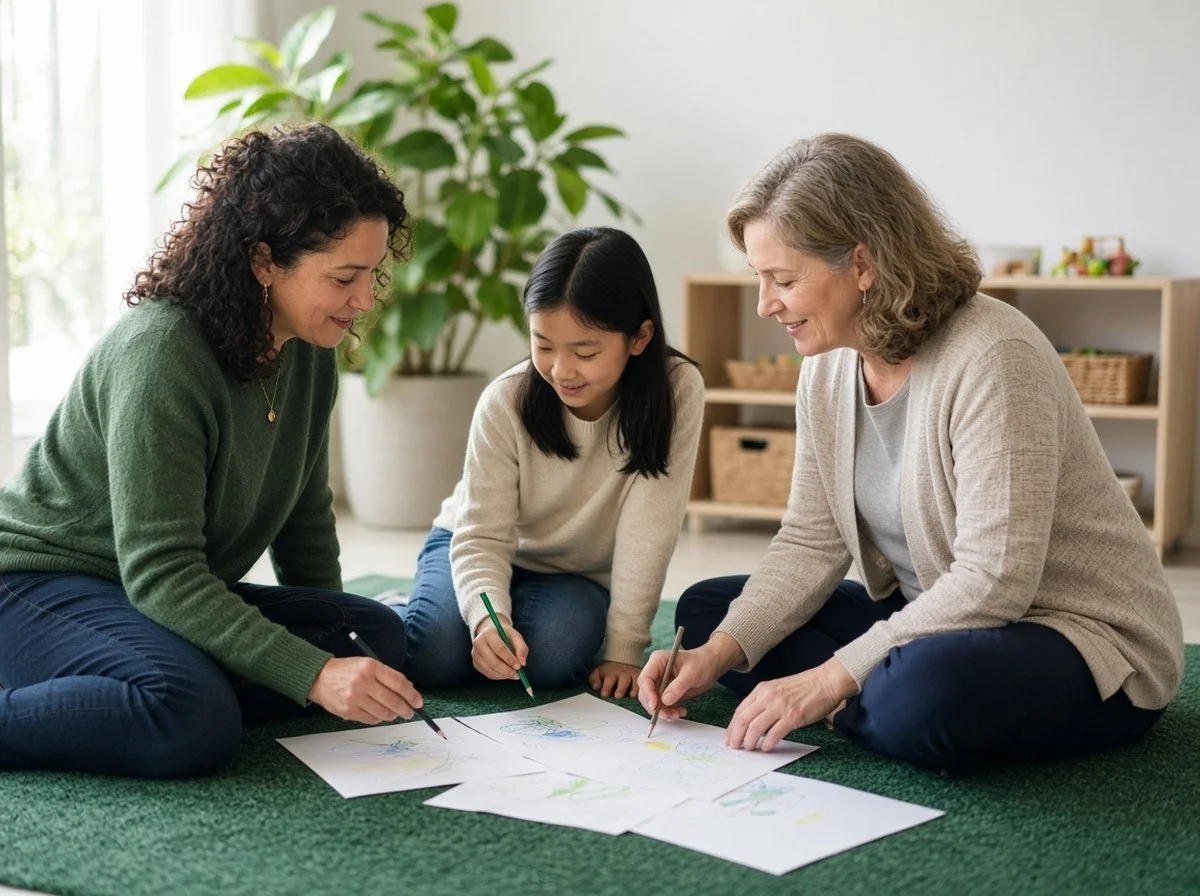
Counselling looks different depending on your child's age and needs. With younger children, sessions often use play, art and stories. Children can show feelings through play that they cannot yet put into words.
Older kids and teens may talk more directly. They might explore questions about identity, culture and birth family. They might work on handling anger, worry or sadness. A counsellor can give them a private space to say things they may not feel ready to say at home.
Our page on counselling for children explains more about how we work with kids and what parents can expect.
Many children do best when parents are part of the process. Sometimes that means a few sessions together. Sometimes it means parent-only sessions alongside the child's work.
How adoptive parents can be supported
Parenting an adopted child can bring unique feelings. You might feel unsure how to talk about birth family, worry about saying the wrong thing or feel hurt when your child pushes you away. Those feelings are normal, and they deserve support too.
A review of parenting programs for foster and adoptive families found that these programs can help strengthen the bond between parent and child and support children's wellbeing (see Sources). Results varied, but the overall picture was hopeful.
Support for parents can take many forms. Some parents prefer one-on-one parent coaching, which focuses on practical tools for everyday moments. Others find that family therapy helps everyone in the home feel heard and work together.
Parents might work on:
Talking about adoption in honest, age-appropriate ways
Staying calm when a child's feelings come out sideways
Making room for a child's questions about birth family
Looking after their own stress and needs
Talking about adoption at home
Many families find it helps to talk about adoption openly and often, starting early. When a child's story is not a secret and is told with warmth, it can feel like a normal part of who they are.
You do not need all the answers. You can say, "That's a big question. I don't know, but I'm glad you asked me." Your openness tells your child that their story is safe with you.
Try to follow your child's lead. Some children ask lots of questions. Others say very little for years and then ask a lot all at once. Both are normal.
Common questions from adoptive parents
Does my child need counselling just because they were adopted? No. Many adopted children never need counselling. It is simply there as an option if questions or struggles come up.
Should I be in the sessions? It depends on your child's age and needs. Younger children often do best with a parent involved. Teens may want more privacy, with some family check-ins.
What if my child does not want to talk about adoption? That is okay. Counselling can focus on whatever your child brings, such as friends, school or worry. Adoption can come up when they are ready.
When to consider counselling
You might consider counselling if your child:
Seems stuck in worry, sadness or anger for weeks at a time
Struggles a lot with trust, friendships or school
Has strong reactions around birthdays, holidays or adoption anniversaries
Asks big questions that feel hard to answer alone
You do not need to wait for a crisis. Reaching out early can make things easier for everyone.
Finding adoption counselling online
Our team offers online therapy for kids across Ontario, which can make it easier to fit sessions into busy family life. Many children feel comfortable meeting from home, where they feel safe.
The free consultation can help match your family with a counsellor who fits your child's age and needs. You can ask questions and share as much or as little as you like.
Cost, billing and your first step
Sessions with our therapists range from $130 to $200, depending on the clinician.
We accept Health Spending Accounts (HSAs).
We can direct bill many insurers. Coverage depends on your plan, so check with your insurer before you start.
Book a free 15-minute consultation with our admin team. We can listen to what your family needs and help match your child or teen with a counsellor who fits.
If you're in crisis: if you or someone you love is in immediate danger, call 911. If you're thinking about suicide, call or text 9-8-8 any time, day or night.
Last reviewed: October 2026
Sources
Keyes MA, et al. "The mental health of US adolescents adopted in infancy." Archives of Pediatrics and Adolescent Medicine, 2008. https://pmc.ncbi.nlm.nih.gov/articles/PMC4475346/
Paine AL, et al. "Charting the trajectories of adopted children's emotional and behavioral problems: The impact of early adversity and postadoptive parental warmth." Development and Psychopathology, 2021. https://pmc.ncbi.nlm.nih.gov/articles/PMC8374623/
Dalgaard NT, et al. "Parenting interventions to support parent/child attachment and psychosocial adjustment in foster and adoptive parents and children: A systematic review." Campbell Systematic Reviews, 2022. https://pmc.ncbi.nlm.nih.gov/articles/PMC8732982/