
You want your partner to really know you. But when it's time to share something real, your throat tightens and you change the subject. If you're wondering how to be vulnerable in a relationship, the good news is that you don't have to do it all at once. Vulnerability can grow one small step at a time.
This post is general information, not medical or relationship advice for your situation.
What vulnerability in a relationship means
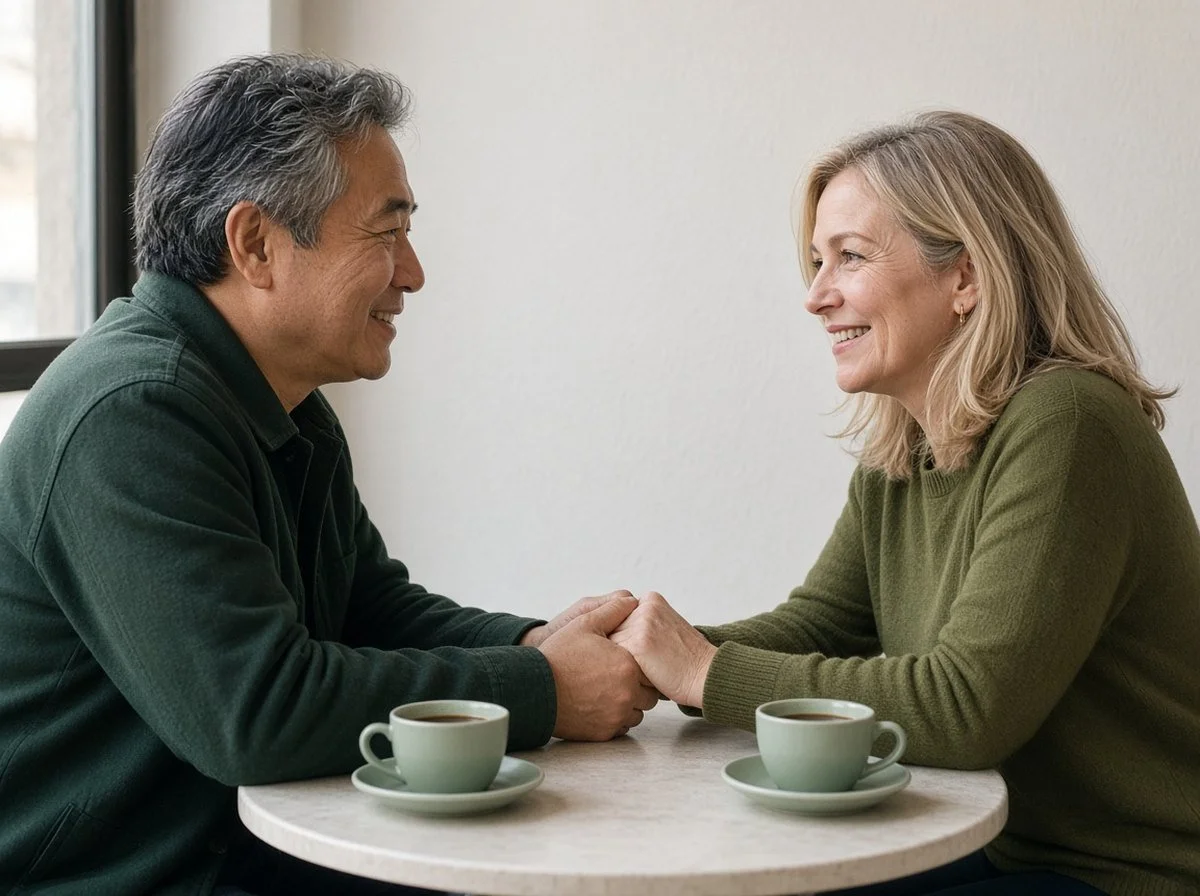
Emotional vulnerability means letting your partner see the parts of you that feel tender. That might be a fear, a need, a hope or a mistake. It means sharing something without knowing for sure how it will land.
Vulnerability is not oversharing or dumping everything at once. It is choosing to open up, bit by bit, with someone who has shown they can be trusted.
Why opening up matters
Research suggests that sharing feelings is part of how closeness grows. In diary studies by Laurenceau and colleagues, people tracked their daily conversations. They felt closer after moments when they or the other person shared something personal, especially when the other person seemed to understand and care. Sharing emotions was more closely tied to feeling close than sharing facts (see Sources).
In other words, telling your partner what happened at work is nice. Telling them how it made you feel is what builds closeness. If you want to read more about that kind of closeness, our post on emotional intimacy goes deeper.
Why being vulnerable feels so scary
The fear of being vulnerable is very common. You might worry about being judged, rejected or seen as weak. If you were hurt when you opened up in the past, your mind may be trying to protect you.
There is also a gap between how we see ourselves and how others see us. In a set of seven studies, Bruk and colleagues found that people judged their own acts of vulnerability, like confessing love or asking for help, more harshly than they judged the same acts in others (see Sources). Your partner may see your openness as brave, even when it feels messy to you.
If you notice you pull away whenever things get close, our post on fear of intimacy may help explain why.
Signs you may be holding back
You might be keeping your guard up if you:
Say "I'm fine" when you're not
Change the subject when talks get personal
Joke your way out of serious moments
Only share good news
Handle problems alone instead of asking for help
Feel lonely even when your partner is right there
None of these make you a bad partner. They are often ways you learned to stay safe.
How to be more vulnerable in a relationship: 7 small steps
Think of this as a ladder. Start on the lowest step that feels doable and move up when you're ready.
Share a small preference. Start with something low-risk. "I'd really like a quiet night in this week." Practising small truths helps you get used to speaking up.
Name a feeling, not just a fact. Instead of "Work was busy," try "Work was busy, and I felt pretty stressed." Adding one feeling word is a big step.
Say what you appreciate. Telling your partner what you love about them can feel exposed, too. "I felt really cared for when you made dinner."
Ask for something you need. Asking for help can feel hard. Try "Could you give me a hug? I've had a rough day."
Share a worry. Let your partner in on something that's bothering you. "I've been nervous about my doctor's appointment."
Talk about something from your past. Share a memory or experience that shaped you. You choose how much to say.
Talk about the relationship itself. This is often the hardest step. "Sometimes I feel far from you, and I miss us." Speak about your own feelings instead of blaming.
You can stay on one step for weeks. There is no rush. It's also normal to slip back a step on a hard day. What matters is that you keep practising, not that you get it perfect. Over time, each small truth you share can make the next one feel a little less scary.
How to open up to your partner in the moment
Some tips can make each step easier:
Pick a calm time. Not in the middle of a fight or when one of you is rushing out the door.
Start with a heads-up. "This is a little hard for me to say."
Use "I" statements. "I feel..." keeps the focus on you.
Keep it short. You don't need a speech. One honest sentence is enough.
Notice your body. If your heart is racing, take a slow breath before you speak.

When your partner opens up to you
Vulnerability works best when it goes both ways. When your partner shares something tender:
Put your phone down and turn toward them.
Listen without fixing or judging.
Say thank you. "Thanks for telling me."
Reflect what you heard. "It sounds like you felt left out."
Keep what they shared private.
How you respond can make it easier or harder for them to open up next time.
If it doesn't go the way you hoped
Sometimes you open up and your partner seems distracted, says the wrong thing or gets defensive. That can sting. It doesn't always mean you were wrong to share.
Try giving it a little time, then come back to it. "When I told you about my worry, I felt a bit brushed off. Can we try again?" Many people need practice responding well, too.
When opening up is not safe
Vulnerability needs safety. If your partner mocks you, threatens you or tries to control you, your safety comes first. Opening up more is not the answer in that case. If you are in immediate danger, call 911.
If you are thinking about suicide or hurting yourself, call or text 9-8-8 now.
How couples counselling can help
Opening up can feel easier with support. In couples counselling, a therapist can help you both slow down, share what's hard to say and respond to each other with care. Some people also find individual counselling helps them understand where their fear of being vulnerable comes from.
We offer couples counselling at our Kitchener-Waterloo, Cambridge and Ottawa offices and online. For online couples sessions, both partners need to be in Ontario.
Common questions about vulnerability in relationships
How do I become more emotionally vulnerable? Start small. Share a preference or a feeling, then slowly move to bigger things like worries and needs.
Why is it so hard to be vulnerable? Fear of judgment or rejection, past hurts and harsh self-judgment can all make it hard.
Can you be too vulnerable? Sharing everything at once, or sharing with someone who hasn't earned your trust, can leave you feeling exposed. Go step by step.
What if my partner doesn't respond well? Talk about it when things are calm. If your partner mocks, threatens or controls you, put your safety first.
Cost, billing and your first step
Sessions with our therapists range from $130 to $200, depending on the clinician.
We accept Health Spending Accounts (HSAs).
We can direct bill many insurers. Coverage depends on your plan, so check with your insurer before you start.
Book a free 15-minute consultation with our admin team. Opening up can feel easier with support.
If you're in crisis: if you or someone you love is in immediate danger, call 911. If you're thinking about suicide, call or text 9-8-8 any time, day or night.
Last reviewed: October 2026
Sources
Laurenceau JP, Barrett LF, Pietromonaco PR. "Intimacy as an interpersonal process: The importance of self-disclosure, partner disclosure, and perceived partner responsiveness in interpersonal exchanges." Journal of Personality and Social Psychology. 1998;74(5):1238-1251. https://doi.org/10.1037/0022-3514.74.5.1238
Bruk A, Scholl SG, Bless H. "Beautiful mess effect: Self-other differences in evaluation of showing vulnerability." Journal of Personality and Social Psychology. 2018;115(2):192-205. https://doi.org/10.1037/pspa0000120