
You wake up after a night out, and before you even open your eyes, the dread hits. What did I say? Did I embarrass myself? Your heart is racing and your mind keeps replaying the night. Hangxiety is a popular word for the anxiety, dread or guilt some people feel the day after drinking. It’s not a diagnosis, but it’s a real and common experience. This post explains why anxiety after drinking happens, why some people get it worse and what can help.
This post is general information, not medical advice. It doesn’t offer hangover cures or remedies. If you have severe symptoms, like shaking, seeing or hearing things that aren’t there, or a seizure, this can be serious. Call 911 in an emergency.
What is hangxiety
Hangxiety meaning is simple: hangover plus anxiety. People use it to describe the nervous, uneasy feeling that can come the morning after drinking.
It might show up as:
a racing heart or a jittery, on-edge feeling
worry or dread that’s hard to explain
replaying conversations from the night before
guilt or shame about what you did or said
feeling irritable or easily upset
Hangxiety symptoms can range from mild unease to strong anxiety. For some people, it fades in a few hours. For others, it lasts most of the day.
Why you can feel anxious after drinking
The National Institute on Alcohol Abuse and Alcoholism (NIAAA) lists anxiety and irritability among common hangover symptoms (see Sources). So if you feel anxious the next day after drinking, you’re not imagining it.
NIAAA also explains that as alcohol wears off, the body can go through a kind of mini-withdrawal. That can leave people feeling more restless and anxious than usual. Alcohol may feel relaxing while you drink. The next day, your body can swing the other way.
How long does hangxiety last? There’s no set answer. NIAAA notes that time is the only thing that truly ends a hangover. The anxious feeling usually eases as your body recovers.
Why some people get it worse
Not everyone gets hangxiety, and some people get it much worse than others. Researchers are just starting to study why.
In a small 2023 study, Tellez-Monnery and colleagues found that hangover anxiety was mostly explained by how anxious people already were in general (see Sources). A 2026 study by Tellez-Monnery and Weber found hangover anxiety was most closely linked to having a hard time managing emotions in the moment, along with general anxiety. In that study, how much people drank seemed to matter less than expected (see Sources).
Both studies were small, and they show links, not causes. But they suggest something useful. If you already live with anxiety, you may be more likely to feel it strongly after drinking.
The mental replay and the shame spiral
For many people, the hardest part of hangxiety isn’t physical. It’s the mind going over and over the night before.
You might:
replay every conversation, looking for mistakes
reread your texts and cringe
assume people are upset with you
jump to the worst possible story
This can turn into a shame spiral. One worry leads to another, and soon it feels like everything went wrong. Remember that anxiety is very good at making stories feel true. A thought like “everyone thinks I’m an idiot” is a feeling, not a fact.

What helps the day after
There’s no quick cure for hangxiety. But some simple steps can help you get through the day more gently.
Ground yourself. Name five things you can see, four you can feel and three you can hear. This brings your mind back to the present.
Breathe slowly. Try breathing in for a count of four and out for a count of six, a few times.
Name the feeling. Tell yourself, “This is hangxiety. It’s uncomfortable, and it will pass.”
Take a short walk. Fresh air and gentle movement can help some people feel steadier.
Check the facts. Before you assume the worst, ask: what do I actually know happened?
Use kind self-talk. Speak to yourself the way you’d speak to a good friend.
If you really did say something you regret, you can make a simple repair later, when you feel calmer. A short message like “Sorry if I came on strong last night” is often enough.
Planning ahead for the next party
The holiday season brings lots of parties, dinners and work events. Planning ahead can help you feel more in control.
Canada’s Guidance on Alcohol and Health, from the Canadian Centre on Substance Use and Addiction, says that when it comes to alcohol, less is better (see Sources). It also suggests that if you drink, you don’t go over 2 drinks on any day. Its tips for drinking less include:
Set a drinking limit ahead of time and stick with it.
Drink slowly.
For every alcoholic drink, have one non-alcoholic drink.
Choose alcohol-free or low-alcohol drinks.
Eat before and while you’re drinking.
Plan some alcohol-free activities.
You can also plan your way home before you go out, and remember that it’s always okay to choose not to drink at all. Having a plan can take some of the worry out of the night, and out of the morning after.
Holiday stress can add to anxiety, too. Our post on Christmas anxiety has ideas for handling the season more calmly.
When anxiety after drinking is worth a closer look
For many people, hangxiety is an unpleasant but occasional experience. Sometimes, though, it’s a sign to look a little closer. You might want support if:
you drink to calm your anxiety, then feel worse the next day
you get strong anxiety every time you drink
you’ve tried to cut back but find it hard
drinking is causing problems at home, at work or with friends
your mood stays low for days after drinking
None of this means something is wrong with you. It means you deserve support. Alcohol and mood can affect each other in a cycle. Our post on alcohol and depression explains how.
How counselling can help
If you are thinking about suicide or hurting yourself, call or text 9-8-8 now. If you or someone else is in immediate danger, call 911.
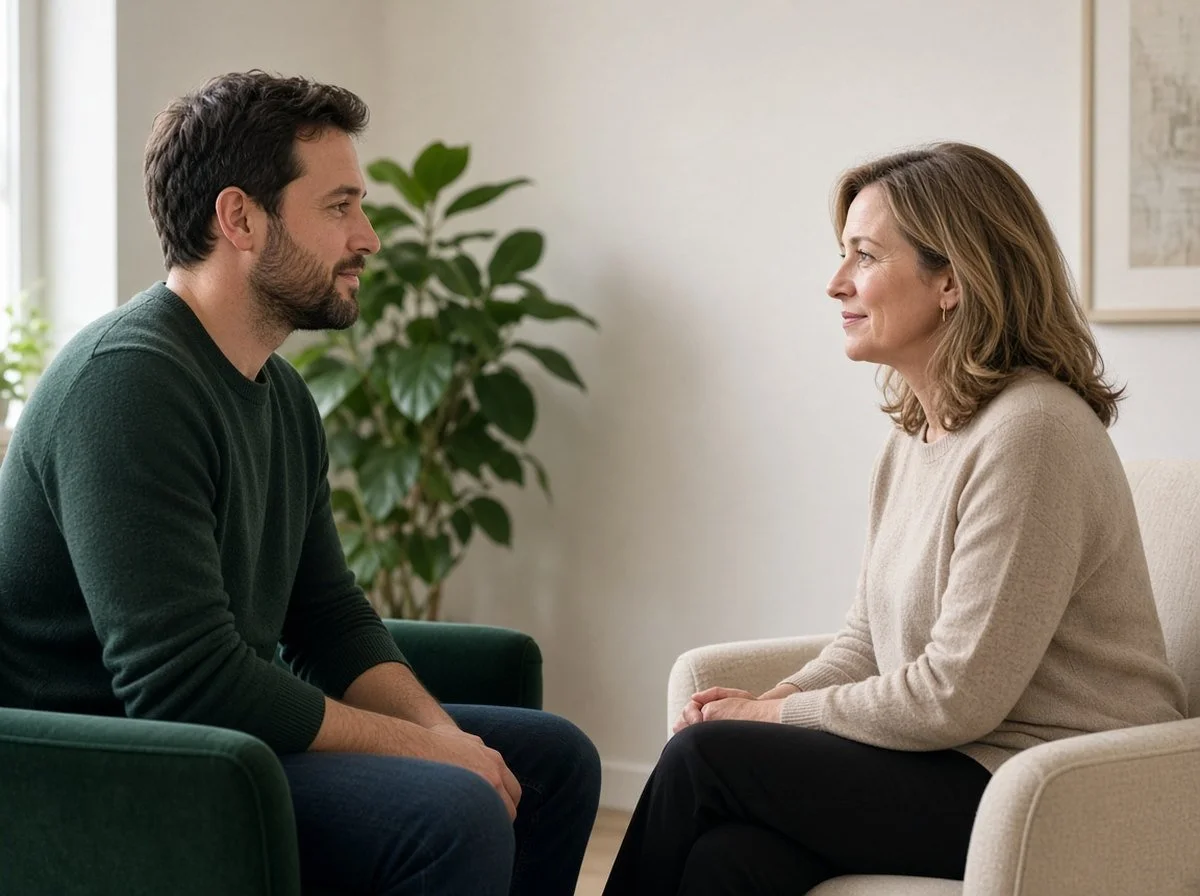
Counselling can help you understand the link between your anxiety and your drinking, without judgment. A therapist won’t label you or tell you what to do. Instead, you work together on what matters to you.
In anxiety counselling, you might:
learn CBT skills to catch and challenge anxious thoughts
find other ways to calm your body and mind
work through shame and self-criticism
make a plan for social events that fits your goals
If you want help with your drinking itself, we also offer addiction counselling. We offer counselling at our Kitchener-Waterloo, Cambridge and Ottawa offices, and online across Ontario.
On the practical side, we can direct bill many insurers, including for sessions with a Registered Psychotherapist (Qualifying). Desjardins is the exception: through TELUS eClaims, we can direct bill Desjardins for sessions with an RSW, RP or psychologist, but not for an RP (Qualifying). Coverage depends on your plan, so check with your insurer before you start.
Book a free 15-minute consultation with our admin team. “I get really anxious after drinking and want to understand why” is enough to start.
If you’re in crisis: if you or someone you love is in immediate danger, call 911. If you are thinking about suicide, call or text 9-8-8, any time.
Hangxiety can feel awful, but it does pass. And if it keeps coming back, that’s a signal worth listening to, not a reason for shame.
Last reviewed: October 2026
Sources
National Institute on Alcohol Abuse and Alcoholism, Hangovers
Canadian Centre on Substance Use and Addiction, Canada's Guidance on Alcohol and Health
Tellez-Monnery K, Berghoff CR, McDermott MJ. Investigating the effects of emotion dysregulation and repetitive negative thinking on alcohol hangover anxiety and depression. Addictive Behaviors, 2023;140:107619
Tellez-Monnery K, Weber AM. The role of emotion dysregulation, illness-related depression, and general anxiety in hangover anxiety. Alcohol, 2026;131:12-20