
The hard part is that you have nothing to hand anybody. No date. No single night. Nothing that would change a stranger's face if you said it at a table. When people talk about trauma they describe a crash or an assault, and you have a childhood that looked fine from the road, or a relationship that ended without police ever being involved, and a strong sense that you are not entitled to any of the words.
Most of the signs of complex PTSD are exactly like that. They are not events. They are settings that got adjusted a long time ago while somebody was surviving something that went on too long to be called an incident. This article maps where those settings show up: your body, how you think about yourself, what you avoid, and what happens when somebody gets close. Reading about it isn't a diagnosis.
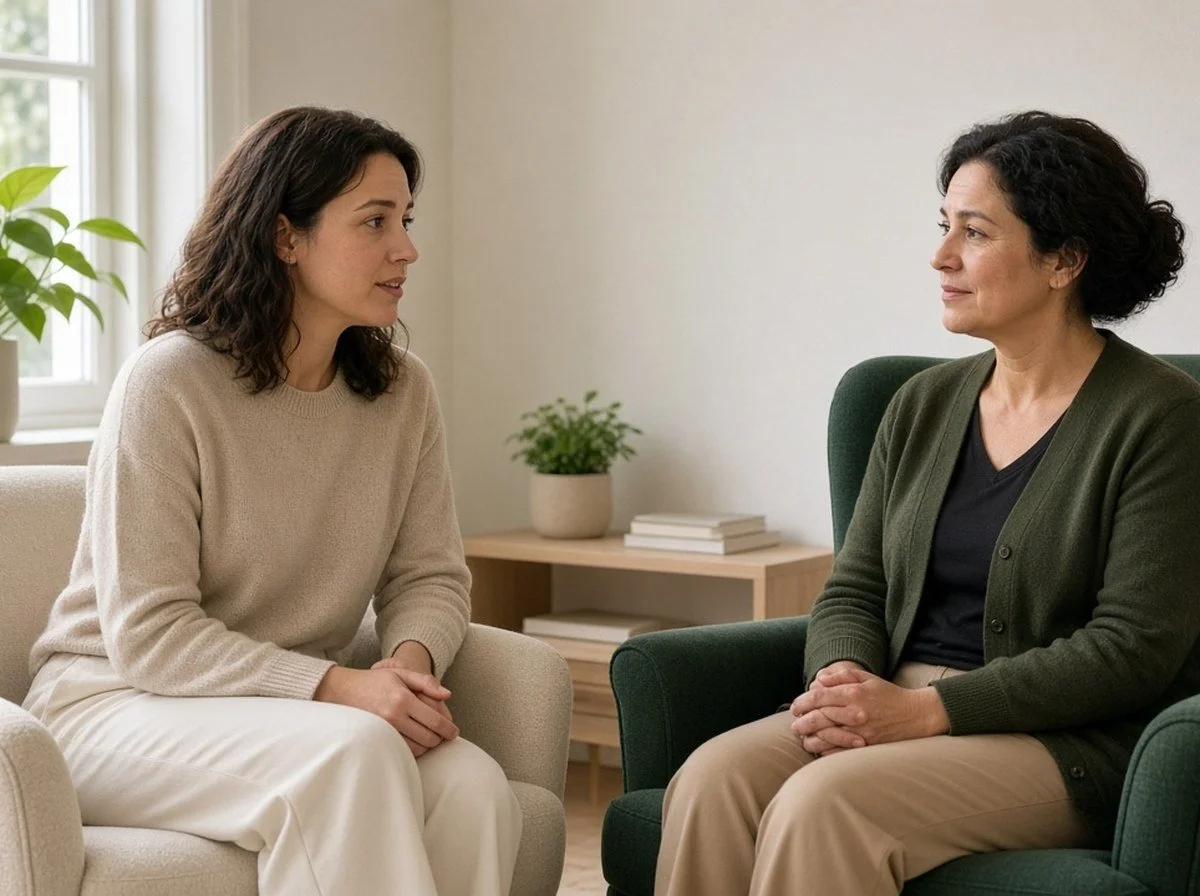
The signs of complex PTSD begin in your body
Ask someone with this history how they are and you'll usually get an accurate report about their week and nothing about their body. The body has been running at a setting they assume is everybody's.
The baseline is high. Muscles that never quite come down, a jaw that aches, shoulders that belong somewhere lower. Sleep that takes an hour to arrive, or that breaks at four with no dream attached to it. Startle is often obvious: someone comes round a corner, a door goes in another room, and your whole system is up before any decision was made. The part people don't expect is how long it takes to come back down. Ten seconds of alarm, forty minutes of aftermath.
Then there is the opposite, and it gets missed because it looks like calm. Shutdown. The volume on everything drops, the room goes slightly further away, your voice sounds like it's coming from a foot to the left. People describe going blank in a difficult conversation, or driving home with no memory of the drive. From the outside that reads as being unbothered. From the inside it is a system pulling the main breaker.
If any of this feels worth a second look, a free 15-minute consultation is a gentle first step, and nobody will ask you to go through what happened.
In how you think about yourself
If PTSD is organized around an event, complex trauma in adults tends to be organized around a conclusion. The conclusion is usually about you, it was drawn early, and it has never been revisited because it doesn't feel like a belief. It feels like a fact.
It sounds like being too much. Or not enough. Or fundamentally different from other people in a way you could never explain but have never doubted. Shame sits underneath rather than guilt, and the distinction matters: guilt says you did something bad, shame says you are something bad, and shame doesn't respond to being told about your achievements.
Memory is often patchy in a way people find unnerving. Whole years of childhood with very little in them. That is common with this history and it is not a sign you are making things up.
And there is the discounting. Whatever happened, you have an explanation ready for why it wasn't that bad, why other people had it worse, and why you should be over it. That explanation is often the most reliable sign on this page.
What is an emotional flashback?
A flashback in the usual sense is a sensory replay. A scene arrives in the present tense, with pictures and sound. Emotional flashbacks have no scene. There is no film. What comes back is the emotional state of a much younger person: small, in trouble, about to be found out, frozen, desperate to fix something.
Because there is no image attached, it doesn't announce itself as a memory. It just feels like the present, and your mind immediately finds a present-day reason for it. Your manager's tone. A partner's silence. A message read and not replied to. The size of the reaction doesn't match the size of the trigger, and afterwards you are left ashamed of having overreacted.
The tell is usually the age of the feeling. If the reaction to a minor thing feels distinctly younger than you are, and it arrives whole, that is worth taking to somebody who works with trauma rather than filing under being sensitive.
In what you avoid without deciding to
Avoidance here is rarely dramatic and almost never conscious. It looks like a personality.
It looks like never being the one who asks for anything. Like leaving a job rather than having one difficult conversation in it. Like being unable to sit still in an unstructured evening, so there is always a task. Like avoiding medical appointments, especially the ones involving being examined. Like being unavailable, always warmly and always with a reason.
Over-functioning is the version that gets praised. Being the competent one, the organizer, the person everyone relies on. It guarantees that you are never in a position of needing anything from anybody. People-pleasing belongs here as well: agreeing before you have checked whether you agree, apologizing for things that aren't yours, managing the mood of the room. That isn't a character trait. It is a strategy that once worked, and it is expensive to run for thirty years.

In your closest relationships
This is where complex trauma announces itself most clearly and where it costs the most.
Closeness sets off two things at once. Wanting it, and bracing for what has historically come with it. That produces a pattern partners find bewildering: real warmth, then a withdrawal that arrives without warning, usually right after a good stretch. From the inside, the withdrawal isn't rejection. It is a system that has decided the exposure has gone on long enough.
Small ruptures land like large ones. A short reply, a partner who is tired and quiet, a friend who takes two days to answer. The alarm reads abandonment and the response is either to over-explain or to go cold first, and both happen faster than thought. Trust is often all or nothing, and it can go from one to the other in an afternoon on evidence that would not convince anybody else.
What complex PTSD is not
A few things need separating, because each one sends people down a different road.
It isn't a formal diagnosis everywhere. Complex PTSD appears in the World Health Organization's classification system, and it does not appear as a separate diagnosis in the manual most North American clinicians use day to day. So an Ontario assessment may return post-traumatic stress disorder, or depression, or an anxiety disorder, rather than the term you arrived with. That doesn't mean you were wrong. It means the label set on the paperwork is narrower than the language people use about themselves. We have laid the two out side by side in complex PTSD vs PTSD.
It isn't a personality problem. It isn't proof of what happened to you. Symptoms aren't evidence, and no honest clinician will reconstruct a history from a symptom list. And it isn't something you need permission to take seriously. The most common thing we hear in a first session is a version of "other people have been through far worse," almost always said by somebody who has been managing this alone for a decade.
Can you have complex PTSD without one clear event?
That is the usual case rather than the exception. The picture is associated with situations that were prolonged, repeated and difficult to get out of, and those are frequently made of ordinary days rather than of incidents. Growing up with a parent whose mood set the weather. Years of being responsible for adults. Emotional neglect, which leaves no story at all because it is defined by what did not happen. A long relationship with steady criticism and no bruises. The absence of a headline event isn't evidence against this. It is one of its features.
Getting help and what to expect
At our practice, psychologists and Nurse Practitioners can assess and diagnose. Our Nurse Practitioners, who see clients in Kitchener, Waterloo and Cambridge, can also prescribe medication when it's needed. Our Registered Psychotherapists and Registered Social Workers provide therapy. You don't need a diagnosis to start therapy.
The work itself tends to go in phases. The first phase is stability: sleep, grounding, managing the shutdown and the flashbacks, and a great deal of work on what your system does before anybody goes near a memory. Processing comes after that, and only if you want it. Nobody should be pushing you into the story in week two. You can read about what happens in an EMDR session, or see how we approach trauma and PTSD counselling. Trauma-focused approaches are designed for unfinished memories that still feel live. CAMH also has a clear overview of posttraumatic stress.
If reading this has brought you close to thoughts of suicide or of hurting yourself, please reach out today rather than waiting for an appointment. Our practice can't offer crisis support. Call or text 9-8-8 any time. In Waterloo Region, call Here 24/7 at 1-844-437-3247. In Ottawa, call the Mental Health Crisis Line at 613-722-6914. If you're in immediate danger, call 911 or go to the nearest emergency department.
Taking the first step
You won't need a referral, and we don't have a waitlist. We've been part of Kitchener-Waterloo since 2016, and we see people in person in Waterloo, Kitchener, Cambridge and Ottawa, or online anywhere in Ontario. Sessions with our therapists are $130 to $200, and there is a one-time $50 setup fee. Sessions with our student therapists are $0 to $80. Many extended health plans cover counselling, and in many cases we can bill your insurance directly, depending on your plan and your therapist. Depending on your plan, your insurance may cover the full session fee.
If this has been sitting at the bottom of your list for a while, a free 15-minute consultation is a small way to move it up, and you decide what happens next.