
Attention-seeking behaviour in children can test any parent's patience. Interrupting, clowning around, whining, breaking rules in front of you or acting out the moment you pick up your phone can all feel like a plea for a reaction. But "attention-seeking" is often another way of saying "connection-seeking." This post looks at why school-age kids, from about age 6 and up, act out for attention, how to respond calmly and when it may be worth looking closer.
This post is general information, not medical advice or a diagnosis.
What attention-seeking behaviour really is
When adults say a child is "just seeking attention," it often sounds like a criticism. But needing attention is not a flaw. Children need adult attention the way plants need light. It helps them feel safe, valued and connected.
Attention-seeking behaviour is what happens when a child does not know a better way to get that need met, or when the better ways have not worked. Some kids learn that the fastest way to get a parent to look up is to do something they are not supposed to do.
Seen this way, the behaviour is a signal. It is not a sign that your child is bad or that you are a bad parent. It is a clue about what your child needs.
Common forms it takes
Attention-seeking can look different from one child to the next. Some common forms are:
Interrupting or talking over adults
Showing off, clowning or being loud
Whining, sulking or exaggerating small hurts
Breaking rules right in front of you
Picking on a sibling when you are busy
Saying "watch me" again and again
Acting out when you are on the phone or focused on a task
Most children do some of these things some of the time. That is normal. It becomes worth a closer look when it happens often, is getting worse or is causing real problems at home or school.
Why children act out for attention
There are many reasons a child might seek attention in ways that feel difficult. Some of the most common include:
Changes at home. A new baby, a move, a separation or a busy season at work can leave a child feeling a bit lost in the shuffle.
Negative attention still counts. To a child, a parent's frustrated response can feel better than no response at all.
Feeling unsure of themselves. Some kids act out when they feel left out, worried or low on confidence. Our blog also has a post on how to help a child with low self-esteem.
Big feelings without words. School-age children are still learning to name and manage emotions. Sometimes behaviour is the only way they can show that something is wrong.
Boredom or tiredness. Sometimes the cause is simple. A tired or bored child may push buttons just to make something happen.
How to respond calmly in the moment
When your child is acting out, it can be hard to think clearly. A few simple steps can help.
Pause before you react. Take a breath. A calm response teaches calm. A big reaction can make the behaviour more likely next time. If you often find yourself shouting, our post on how to stop yelling at kids has practical ideas.
Give a clear, simple instruction. Instead of "Stop being silly," try "Please sit down and use a quiet voice." Clear, specific instructions are easier for children to follow.
Use brief, calm consequences. Research supports this. A large review of parenting studies found that clear instructions, along with brief, calm consequences such as a short time-out or briefly ignoring the behaviour after a child does not follow an instruction, helped children follow instructions more often (see Sources).
Ignore small, harmless behaviour. If your child is being loud or silly but not unsafe, calmly turning your attention away for a short time can help. Then turn back warmly the moment they stop.
Stay safe. If behaviour is unsafe, step in right away. Ignoring is only for small, harmless actions.
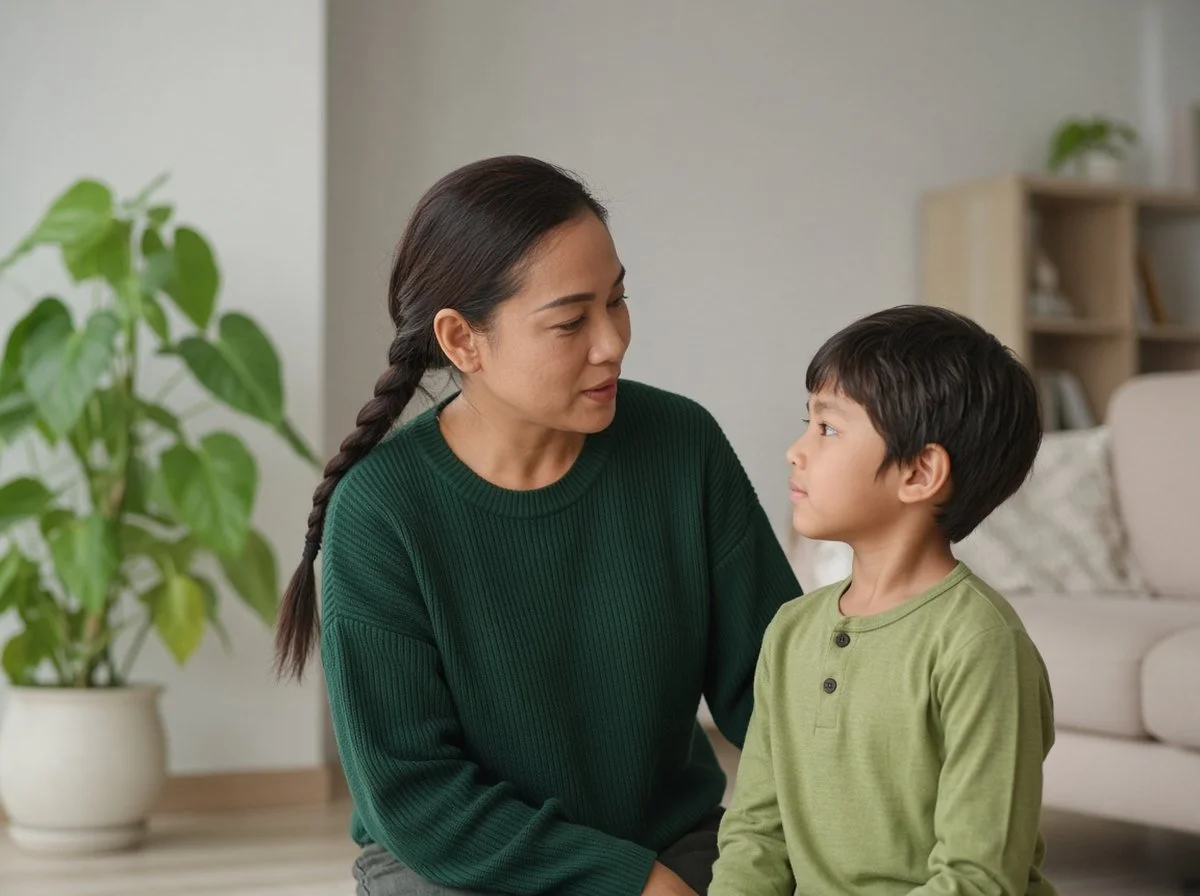
Building connection before the acting out
The best long-term approach is often to fill your child's need for attention before they go looking for it. Small, steady moments of connection can make a big difference.
Try short, daily one-on-one time. Even a few minutes of your full attention, with no phone and no agenda, can help. Let your child choose the activity.
Notice the good moments. Warm attention when your child is calm, kind or helpful shows them they do not have to act out to be seen. Think of this as connection, not as a trick to make them obey. The same review did not find that praise on its own made children more likely to follow instructions (see Sources). But warmth matters for your relationship in its own right.
Give a heads-up before you get busy. If you need to take a call, try saying, "I need ten minutes. Then I'm all yours." Then follow through.
Name feelings out loud. "You seem frustrated that I'm busy" can help your child feel understood. Over time, it can help them use words instead of actions.
What tends to backfire
Some common responses can make attention-seeking worse, even when they come from a good place:
Long lectures. A long talk in the heat of the moment gives a lot of attention to the very behaviour you want less of.
Harsh or shaming words. Calling a child "needy" or "dramatic" can hurt their sense of self and leave the real need unmet.
Giving in to stop the noise. If whining always works, a child learns to whine more.
Being inconsistent. When the response changes from day to day, children may keep testing to find out where the line is.
Nobody gets this right every time. If you slip, a simple repair helps. You might say, "I got really frustrated earlier. I'm sorry I yelled. Let's try again." Repair shows your child that the relationship is safe, even after a hard moment.
When to look closer
Most attention-seeking is part of normal development. Health experts note that many changes in behaviour and mood are a typical part of growing up (see Sources). But some signs suggest it is worth getting more support. These include:
Behaviour that lasts for weeks and is getting worse
Big changes in sleep, mood or appetite
Trouble at school or with friends that does not settle
Behaviour that puts your child or others at risk
A feeling that nothing you try is helping
If you notice these signs, reaching out is a good step. It does not mean you have failed. It means you are paying attention.
How counselling and parent coaching can help
Sometimes children need a space of their own to work through what is going on. Our counselling for children page explains how we work with kids and what parents can expect.
Parents can also get support. Parent coaching focuses on practical tools for everyday moments, like what to say when your child acts out and how to build more connection at home. Our team offers sessions in person and online across Ontario.
Cost, billing and your first step
Sessions with our therapists range from $130 to $200, depending on the clinician.
We accept Health Spending Accounts (HSAs).
We can direct bill many insurers. Coverage depends on your plan, so check with your insurer before you start.
Book a free 15-minute consultation with our admin team. We can talk through what you are seeing at home and help you choose between child counselling and parent coaching.
If you're in crisis: if you or someone you love is in immediate danger, call 911. If you're thinking about suicide, call or text 9-8-8 any time, day or night.
Last reviewed: October 2026
Sources
Leijten P, et al. "Parenting behaviors that shape child compliance: A multilevel meta-analysis." PLOS ONE, 2018. https://pmc.ncbi.nlm.nih.gov/articles/PMC6173420/
National Institute of Mental Health. "Children and Mental Health: Is This Just a Stage?" https://www.nimh.nih.gov/health/publications/children-and-mental-health