

You're talking with a coworker, and your eyes keep sliding to the floor, the wall, anywhere but their face. Holding their gaze feels intense, almost exposing. Or maybe you've noticed someone you care about always looks away when you talk. If you've ever asked, "Why do people with social anxiety avoid eye contact?", you're not alone. This guide explains why eye contact can feel so intense with social anxiety, how looking away works as a safety behaviour, why not everyone who looks away is anxious and small ways to get more comfortable.
This post is general information, not a diagnosis. Only a qualified professional can assess social anxiety or any other condition.
Eye contact and social anxiety
Social anxiety is a strong fear of being judged, embarrassed or rejected in social situations. For many people with social anxiety, eye contact is one of the moments where that fear feels sharpest.
So, is avoiding eye contact a sign of anxiety? It can be, but not always. Social anxiety eye contact struggles are common, but looking away has many possible causes. It's one piece of a bigger picture, never proof of anything on its own.
When you're socially anxious, meeting someone's eyes can feel like being seen too clearly. You might worry they'll notice you're nervous, read something in your face or judge you. Looking away offers a little relief, a sense of hiding in plain sight.
Feeling watched and judged
A well-known way of understanding social anxiety, the cognitive model developed by psychologists David Clark and Adrian Wells, describes how fear of being judged can turn a person's attention inward. Instead of focusing on the conversation, they focus on themselves: how they look, whether they're blushing, whether their voice sounds shaky.
That inward focus can make eye contact feel even harder. You're already monitoring yourself closely, and someone's gaze can feel like a spotlight. You might imagine they can see exactly how anxious you feel, even when they can't.

Looking away as a safety behaviour
In this model, safety behaviours are small things people do to feel less exposed, like avoiding eye contact, speaking very little or rehearsing what to say. They make sense. They bring quick relief.
But research suggests they can also keep social anxiety going. A study published in PLOS ONE found that self-focused attention combined with safety behaviours increased anxiety in socially anxious teens. Part of the reason is that safety behaviours stop you from learning that the situation might have gone fine anyway. If you always look away, you never get to find out that eye contact may be more manageable than you fear.
None of this means looking away is wrong. It's an understandable way to cope, and it often happens without you even noticing. It just helps to know why it can make anxiety stick around.
Not everyone who looks away is anxious
It's important not to read too much into eye contact, especially someone else's. Avoiding eye contact is not a sign of lying, rudeness or disinterest. People look away for many reasons:
Culture. Eye contact norms vary. A study in PLOS ONE comparing Japanese and Finnish participants found that people from the two cultures rated faces making direct eye contact differently, which the researchers linked to cultural norms.
Personal preference. Some people simply think or listen better when they're not looking at someone's face.
Autism. The NHS lists using eye contact less often among possible signs of autism. For autistic people, eye contact can be uncomfortable or distracting, and that's not the same as anxiety.
Focus and attention. Some people, including some people with ADHD, may find it easier to concentrate on words when they look away.
Mood. When someone feels low or exhausted, eye contact can take energy they don't have.
We can't tell why a particular person avoids eye contact by watching them. If you're wondering about yourself, a professional assessment is the way to understand what's going on, not a checklist.
What it can feel like at work and in dating
At work, anxiety and eye contact can collide in meetings, presentations or even quick hallway chats. You might worry your boss sees you as unconfident, or that coworkers think you're unfriendly.
In dating, eye contact can feel especially loaded. You might want to connect and still find yourself looking at your drink, your hands or the table. It can feel frustrating to want closeness while your anxiety pulls you away.
These experiences don't mean you're bad at relationships. They mean anxiety is getting in the way. You may find that once you feel more at ease with someone, eye contact gets a little easier on its own. Give yourself credit for showing up, even if your eyes wander.
How to make eye contact with social anxiety
If you'd like to feel more comfortable, here are some gentle ideas. They're not a plan to force yourself through, just small things to try if they feel right:
Start with people you trust. Practise brief eye contact with a friend or family member.
Look near the eyes. Glancing at someone's eyebrows or the bridge of their nose can feel easier.
Take natural breaks. Most people look away often during conversation. You don't need to stare.
Shift your focus outward. Get curious about what the other person is saying, rather than how you look.
Be kind to yourself. Notice small moments of progress, without harsh judgment.
If eye contact still feels very hard, that's okay. Social anxiety responds well to support.
When to reach out for support
Is avoiding eye contact a sign of social anxiety that needs attention? On its own, not necessarily. It may be worth talking with someone if fear of being judged is affecting your work, school, friendships or dating life, if you avoid situations you'd like to be part of, or if you spend a lot of time dreading or replaying conversations. You don't need to wait until it feels unbearable. Support can help at any stage, and you don't need a diagnosis to start.
For partners, friends and coworkers
If someone you know avoids your eyes, try not to take it personally or point it out. Comments like "Why won't you look at me?" can increase self-consciousness. Instead, focus on warmth and listening. Feeling accepted can help people relax over time.
How counselling helps social anxiety
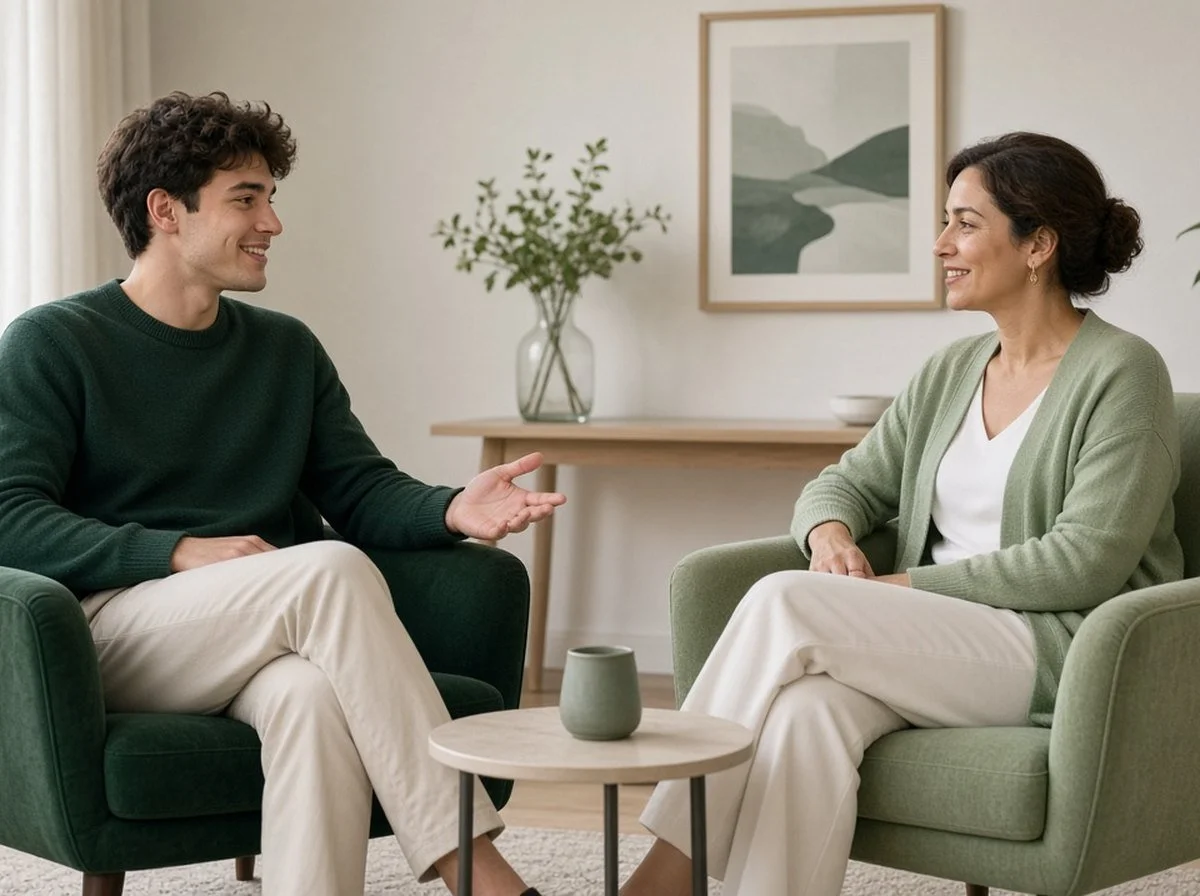
Counselling can help you understand what drives your social fear, notice self-focused attention and safety behaviours, and build confidence at your own pace. Approaches like cognitive behavioural therapy (CBT) can help you challenge anxious predictions and try new ways of being in social situations, with a therapist guiding the process.
We offer counselling for anxiety, including social anxiety, at our Kitchener-Waterloo, Cambridge and Ottawa offices, and online anywhere in Ontario on a secure, encrypted video platform. Online sessions can be a comfortable first step if face-to-face conversations feel hard.
Sessions with our therapists range from $130 to $200, depending on the clinician.
Depending on your plan, insurance may cover some or all of the cost. Coverage varies, so check your plan.
We accept Health Spending Accounts (HSAs).
We can direct bill many insurers, including for sessions with a Registered Psychotherapist (Qualifying). Desjardins is the exception: through TELUS eClaims, we can direct bill Desjardins for sessions with an RSW, RP or psychologist, but not for an RP (Qualifying).
Book a free 15-minute consultation with our admin team. It's a phone call, so there's no eye contact needed.
If you're in crisis: if you or anyone else is in immediate danger, call 911. If you're having thoughts of suicide, call or text 9-8-8 any time. More options are on our crisis lines page.
Looking away doesn't define you. With support, conversations can start to feel a little easier.
Last reviewed: October 2026