
Music and mental health are linked for many people. A song can calm you, lift you or help you cry. Everyday listening is not the same as music therapy, and Transformation Counselling does not offer music therapy. This post looks at what research suggests about the benefits of music on mental health, how to use music for stress relief and anxiety, and when a playlist is not enough on its own.
This post is general information, not medical advice or a diagnosis.
The benefits of music on mental health, what the research shows
Music can touch mood, memory and the body. A familiar song may settle your breathing. An upbeat track may help you get moving. The benefits of music on mental health are real for many listeners, but the research on everyday listening is mixed.
A 2022 review by Adiasto and colleagues looked at fourteen lab experiments on music listening after a stressful task. Overall, the effect of music on stress recovery was not clearly significant. The authors described the evidence as mixed (see Sources).
That does not mean music is useless. It means we should speak carefully. Music can be a helpful tool. It is not a cure, and it does not replace support when you need more help.
How music moves the body
Music can change breathing, heart rate and muscle tension for some listeners. A slow song may invite longer exhales. A driving beat may help you start a task you have been putting off.
You do not need special training to notice this. Pay attention to your shoulders, jaw and stomach while you listen. If your body softens, that playlist may be a good calm down tool. If you feel wired, switch tracks.
Music also ties to memory. A song from a hard year can bring feelings back fast. That can be useful for processing, or too much on a fragile day. You get to choose when to press play.
Music for stress relief and anxiety
Music for stress relief often means slower, familiar music you already like. Music for anxiety can look the same: something that helps your body settle rather than rev up.
Try pairing a calm playlist with slow breathing. Sit or lie down, notice your feet on the floor and let the music be a background cue to unwind. Our post on how to calm your nervous system has more settling ideas.
Stress and anxiety are related but not identical. If you are unsure which you are dealing with, our post on stress vs anxiety explains the difference in plain words.
Using playlists on purpose
Build a few short playlists with a clear job:
Calm-down: soft, familiar songs for winding down
Get-moving: music that helps you start a walk or chores
Feel-it: songs that let you feel sad or angry safely for a set time
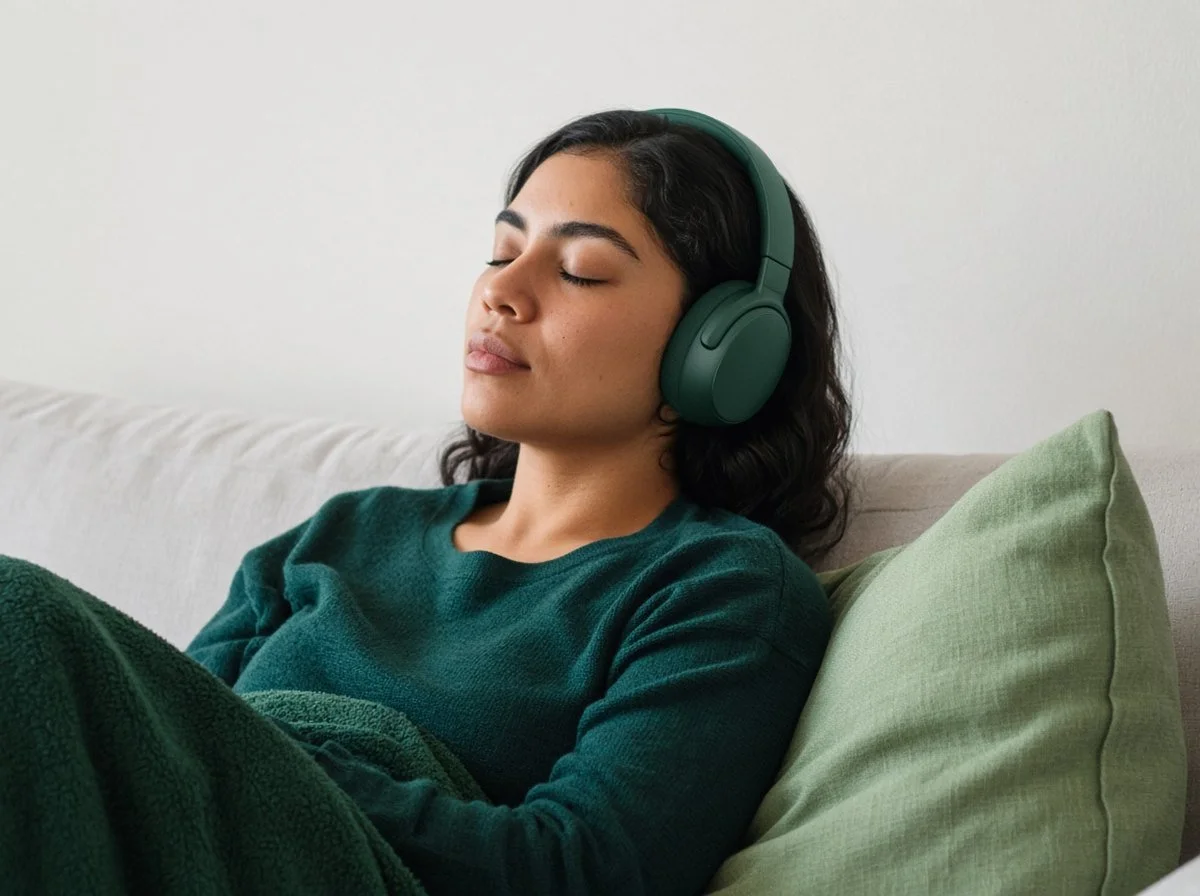
Notice how you feel when each playlist ends. That feedback tells you what helps. You can use music while walking, cooking or getting ready for sleep. Keep volume reasonable and leave room for rest without headphones too.
Building a kind listening habit
Pick one or two times a day for intentional listening, such as after work or before bed. Keep sessions short at first, like one album side or three songs. Put your phone face down so you are not scrolling while the music plays.
Share a calm playlist with a partner or friend if that feels connecting. Or keep it private. Both are fine. The goal is to use music on purpose, not to fill every silence.
When music keeps you stuck
Music can also keep hard feelings looping. Watch for:
Playing sad songs on repeat until you feel worse
Using music to avoid a conversation or a feeling
Headphones as a full-time shield from people you care about
If a playlist leaves you more stuck than soothed, switch it or take a break. Gentle checks like “How do I feel after three songs?” can help you stay in charge.
Listening, music therapy and counselling
Music therapy is a separate treatment delivered by credentialed music therapists. A 2025 review by de Witte and colleagues found that music therapy delivered by trained music therapists can reduce anxiety (see Sources). Transformation Counselling does not offer music therapy. We want that to be clear so no one expects a service we do not provide.
Everyday listening can still support your mood. When anxiety or low mood need more than a playlist, counselling can help. Learn more about our anxiety therapy.
We offer counselling at our Kitchener-Waterloo, Cambridge and Ottawa offices, and online across Ontario. Every clinician on our team is registered with their college.
If you are thinking about suicide or hurting yourself, call or text 9-8-8 now. If you or someone else is in immediate danger, call 911.
Music, sleep and evenings
Many people put on music late at night. Soft sound can make a room feel safer. Loud or exciting tracks close to bedtime can keep your mind awake.
If sleep is already hard, try a short calm playlist earlier in the evening. Stop the music when you get into bed, or use a very quiet, familiar set of songs. Notice whether you fall asleep more easily on music nights or quiet nights. Use what your body tells you.
Music is one evening tool among many. A warm drink, dim lights and a simple wind down routine can sit beside it.
What counselling can look like
In counselling, you and your therapist set goals that fit your life. Sessions may include talking through patterns, practising a skill and planning one small step for the week. You set the pace.
You do not need a crisis to start. Many people come because life feels heavier than it should, or because an old pattern keeps repeating. A free 15 minute consultation can help you find a fit, in person or online across Ontario.
Progress is often quiet at first. You may notice you catch a reaction sooner, sleep a little better or speak a little more honestly. Those shifts matter even when they are small.
Bring questions. Bring doubt. Bring the messy middle. Therapy is a place for all of that.
A note on pacing and energy
Hard weeks ask for a lighter load. On those weeks, shrink your goals. One walk. One honest talk. One early night. Pushing through every time is not the same as strength.
Protect a little quiet in your day if you can. Quiet helps your nervous system settle so you can think more clearly. If quiet is rare in your home or job, even five minutes in a parked car or a bathroom break with slow breaths can help.
You are allowed to need rest without earning it.
Sharing music without pressure
You do not have to like the same songs as your partner, friends or kids. Shared listening can be sweet. Forced listening can create tension.
If someone in your life uses loud music to shut the world out, you can still ask for quiet hours in shared spaces. Kind limits protect the home. Music should not become a wall no one can cross.
If music is one of the only things that soothes you right now, that is useful information. It may also be a sign that stress or anxiety needs more support than sound alone.
Common questions about music and mental health
Can music help with anxiety? It may help some people settle, especially with slower music they like. Evidence for everyday listening after stress is mixed.
Is music good for mental health? It can be a helpful tool. It is not a replacement for care when you need more support.
What kind of music reduces stress? Often music that is familiar and calming to you. There is no single playlist that works for everyone.
What is the difference between music therapy and listening to music? Music therapy is a credentialed treatment. Everyday listening is a personal coping tool. We do not offer music therapy.
Bringing this into daily life
Change sticks when it fits your real week. Choose one idea from this post and try it for seven days. Keep it small. Tell a trusted person if that helps you follow through.
If the idea does not fit, drop it and pick another. You are gathering information about what helps you, not performing wellness.
Counselling can help when you want a guide for the harder parts. A free 15 minute consultation is a low pressure way to see whether talking with someone feels useful right now.
Sleep, food, movement and safe connection make every mental health effort easier. You do not need perfect habits to deserve support. Good enough care still counts.
If a day goes badly, start again the next morning without a speech to yourself. Restarting is a skill. Soft restarts beat harsh resets.

Cost, billing and your first step
Individual sessions with our therapists range from $130 to $200, depending on the clinician.
Couples and family sessions range from $170 to $200.
Student therapist sessions range from $0 to $80.
We accept Health Spending Accounts (HSAs).
We can direct bill many insurers, including for RP (Qualifying) clinicians. Some plans cover up to 100% of the session fee. Coverage still depends on your plan, so check with your insurer before you start.
Book a free 15-minute consultation with our admin team. We can help you find a therapist who fits what you need, in person or online.
If you’re in crisis: if you or someone you love is in immediate danger, call 911. If you’re thinking about suicide, call or text 9-8-8 any time, day or night.
Last reviewed: November 2026
Sources
Adiasto K, Beckers DGJ, van Hooff MLM, Roelofs K, Geurts SAE. “Music listening and stress recovery in healthy individuals: A systematic review with meta-analysis of experimental studies.” PLOS ONE. 2022;17(6):e0270031. https://pmc.ncbi.nlm.nih.gov/articles/PMC9205498/
de Witte M, Aalbers S, Vink A, et al. “Music therapy for the treatment of anxiety: a systematic review with multilevel meta-analyses.” eClinicalMedicine. 2025;84:103293. https://pmc.ncbi.nlm.nih.gov/articles/PMC12179724/