
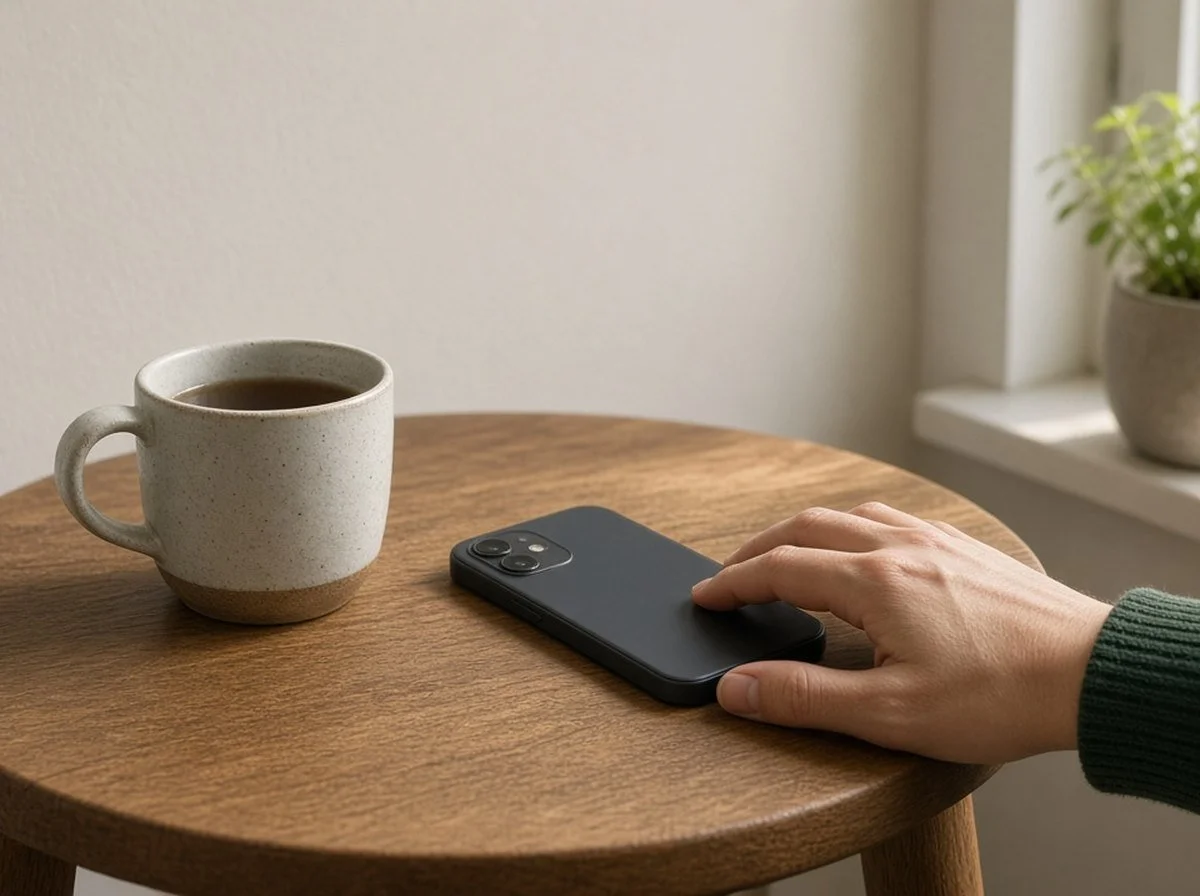
Offered a choice between bad news today and no news until Friday, part of you would take the bad news. The clinic said they'd phone if anything came up. They haven't, and the silence is worse than any result you can imagine, because at least a result would be something to hold.
That preference, bad-and-known over unknown-and-maybe-fine, is intolerance of uncertainty in a single sentence. It sits under a great deal of what people call worry, and it lands in four places: your body, your thinking, what you do, and your relationships. Your body comes first, because that's what sends most people looking.
What is intolerance of uncertainty?
Intolerance of uncertainty is a tendency to find not knowing hard to bear, whatever the outcome turns out to be. Researchers who study worry describe it as a trait, not a diagnosis. Everyone has some of it. It becomes a problem when it starts running your days.
In your body
Not knowing keeps the alarm half on. Your nervous system doesn't draw a sharp line between a threat that's here and a threat that might be coming, so it braces for both. That shows up as a jaw you keep unclenching, shoulders that live near your ears, and a stomach that's off for no reason a doctor can find.
Sleep is the clearest sign. You can drop off fine on a night when tomorrow is settled, and lie awake for hours when one thing is open, even a small thing. Some people notice their heart pick up when a phone rings from an unknown number. Others describe a restlessness that won't let them sit through a show, because sitting means waiting and waiting means feeling it.
There's also a particular tiredness that follows a stretch of not knowing. Once the answer finally comes, even a bad one, the body often slumps. Some people are surprised to feel calmer after hard news than they did in the weeks before it. In one lab study, not knowing whether a shock was coming was more stressful than knowing it would. It's often the not-knowing that was costing you, not the fact.
If the waiting is what's been wearing you out, a free 15-minute consultation is a small thing to try before anything bigger.
In your thinking
Why does not knowing make me anxious? Because your mind treats a gap as a threat and fills it with the worst thing that fits. Brains like tidy answers. They'd rather have a bad certainty than an open question, and they'll reach for a shortcut to close the gap fast. The shortcut tends to be negative, because people weigh possible losses more heavily than possible gains.
So the thoughts have a familiar shape. What if the test is bad. What if she's not texting because she's done. What if the job falls through. Each one comes with a full storyline attached, and by the time you notice, you've lived through it three times. This is where uncertainty and anxiety join up. Worry feels like preparation. It's your mind trying to reach the end of the story early so it can stop being scared, and it never gets there, because the story hasn't happened yet.
Mixed feelings are hard for the same reason. Wanting the move and dreading the move, loving someone and being angry at them, both at once, leaves a question open. People with a strong need for closure tend to resolve mixed feelings early, pick a side, and stop thinking. The cost is flexibility. A paperclip is a paperclip, unless you can hold the question open long enough for it to become a screwdriver.
In what you do and avoid
Intolerance of uncertainty is easiest to see in behaviour, because behaviour is where you try to make the not-knowing stop.
Checking. Refreshing the results portal. Rereading the text thread for tone. Tracking the parcel, and then your teenager's location, and then the weather for a trip two weeks away.
Asking for reassurance. "Do you think it's fine?" answered, then asked again in a different form an hour later.
Over-researching. Reading the ninth article on the same symptom, or comparing the same two cars for a month.
Putting off decisions. Not because you don't know what you want, but because choosing means giving up the option you didn't pick.
Avoiding altogether. Not applying. Not asking. Not booking the appointment. If you don't find out, you don't have to know.
Doing everything yourself. Delegating means not knowing how it'll be done.
Each of these buys a few minutes of relief and teaches your alarm that the relief came from the checking. So next time it asks for more. That loop keeps a lot of worry going, and it's why the pattern often looks like ordinary carefulness from the outside. If the loop mostly runs in your head, our guide on how to stop ruminating has tools for it.
In your relationships
The people close to you are usually on the receiving end of the checking. A partner gets the "are we okay?" question after every quiet evening. A friend gets a message, then a follow-up asking whether the first message was weird. A parent gets a call whenever a decision is pending, because someone else's certainty feels better than your own guess.
Over time that wears on both sides. The person being asked starts to feel like a reassurance machine. The person asking starts to feel like a burden, and says less, which raises the uncertainty, which raises the asking. Some people go the other way and become the one who decides everything and can't let anyone else book the restaurant. Control is how not-knowing gets managed when reassurance isn't available.
There's a gentler side too. Hearing how a friend sat through their own scare and came out the other side gives your nervous system a shape to borrow.

What intolerance of uncertainty is not
It's not a diagnosis. You won't find it as a condition on its own in the manuals clinicians use in Ontario.
It's not the same as anxiety. It's a thread that runs through several anxiety problems, generalized worry most of all, and it's a target in cognitive behavioural therapy (CBT) for that reason. Having the trait doesn't mean you have a disorder.
It's not weakness, and it's not a lack of intelligence. Some very sharp people are the most bothered by open questions, because they can picture so many endings.
It's not the same as being in a bad situation. Waiting on a biopsy is hard for everyone. The trait shows in how much harder, and in whether the same dread shows up over a delayed text.
And it's not a fixed setting. Tolerance for ambiguity can grow, the way tolerance for anything grows, by being in contact with the thing in small doses.
What actually drives it
Underneath the checking and the storylines, a few things keep it going.
A belief that uncertainty itself is dangerous. Not the bad outcome. The state of not knowing. Once that belief is in place, every open question feels like an emergency.
A belief that worrying helps. If you think running the worst case protects you, you'll keep running it. It doesn't protect you. It rehearses you.
A history where not knowing did cost you. If you grew up in a home where the mood could turn without warning, or an earlier scare went badly, your body learned that gaps hide danger. That's a reasonable lesson from an unreasonable time, and it can be updated.
And the loop itself. Every check and every avoided decision confirms the belief that you couldn't have stood the not-knowing. You never find out that you could.
How to get better at handling uncertainty
Not by getting more certain. By practising being in contact with the unknown and noticing you survive it. Counsellors who work on worry do this on purpose:
Send the text and don't check for a reply.
Make the small decision without polling three people.
Put the open question on paper for a few minutes a day, with no editing and no need to solve it.
Say both halves of a mixed feeling out loud, "I want the move and I'm dreading it", and leave the sentence unresolved. Nothing breaks.
It's worth talking to someone if the worry is costing you sleep most nights, you're avoiding things that matter, or it has turned into thoughts of not wanting to be here. If that last one is happening, please reach out now:
Call or text 9-8-8 from anywhere in Canada.
Here 24/7 answers at 1-844-437-3247 across Waterloo Region.
In Ottawa, the Mental Health Crisis Line is 613-722-6914.
Call 911 if you are in immediate danger.
How counselling helps with worry
That work is the core of how we treat worry, and our page on anxiety counselling explains more. We have five offices, in Waterloo, Kitchener, Cambridge and Ottawa, and video sessions reach anyone else in Ontario. We've been seeing clients since 2016. You don't need a doctor's referral. In many cases we can bill your insurance directly, depending on your plan and your therapist.
Frequently asked questions
Is intolerance of uncertainty a mental illness?
No. It's a trait that everyone has to some degree. It can feed anxiety problems, which is why therapy often works on it directly.
Can intolerance of uncertainty be treated?
Yes. CBT often targets it, mainly through small, planned practice with not knowing.
Taking the first step
You don't have to know whether counselling is right for you before you call. Booking a free 15-minute consultation is one open question you can close today.
If you are in crisis, call or text 9-8-8, or call Here 24/7 at 1-844-437-3247. In an emergency, call 911.