
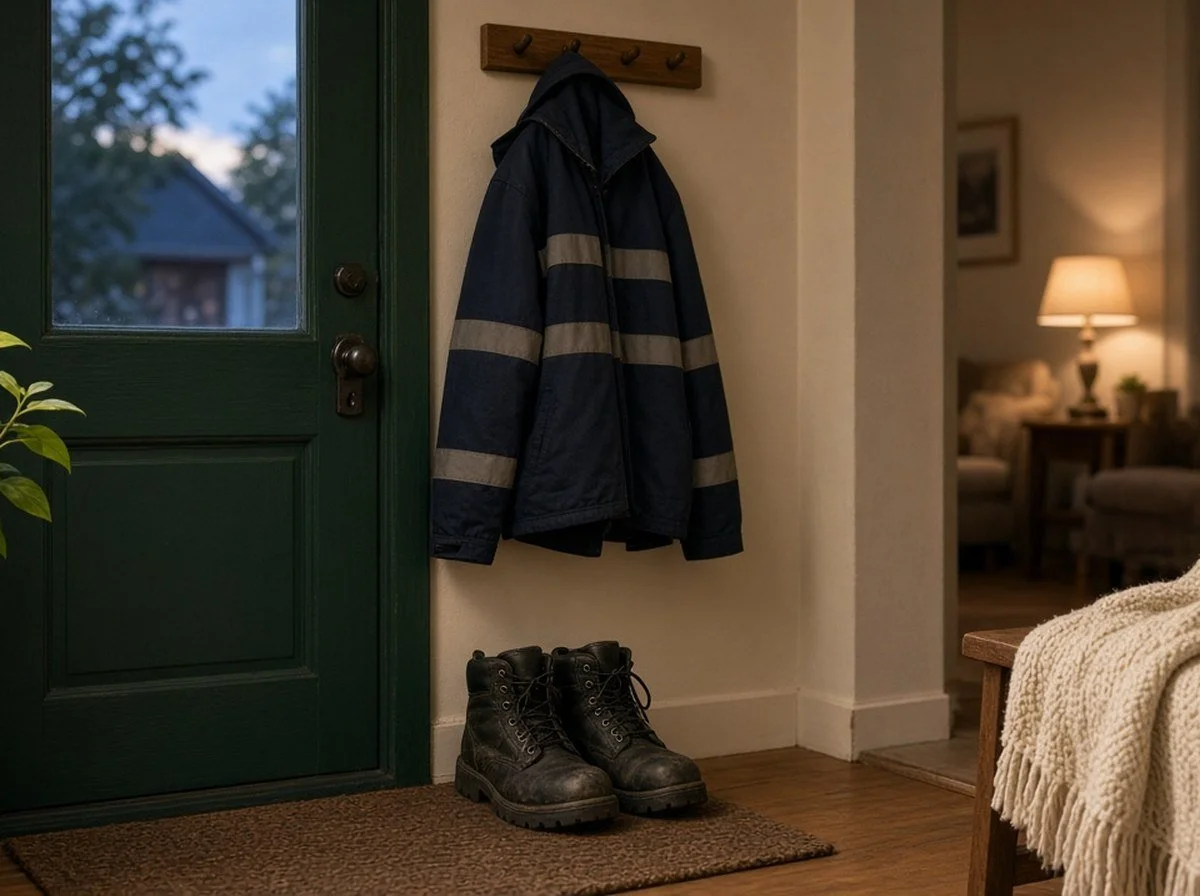
Most of the calls go. Thousands of them, gone by the end of the shift, gone by the time you're back on the road. Then there are the three or four you could still describe in order, down to the weather and who was standing where. At least one of those was ordinary enough that nobody else on the crew would remember it at all. That's the part of first responder mental health nobody covers in training.
In Ontario, there's a route through the Workplace Safety and Insurance Board (WSIB) that almost everyone knows half of. The half that gets passed around the hall is rarely the useful half. Here's how that route works, what it covers, and what care costs if you'd rather keep it to yourself. Our own fees were last checked in September 2026.
The short answer on first responder mental health in Ontario
Say you work in a covered role and a psychologist or psychiatrist diagnoses you with post-traumatic stress disorder (PTSD). Ontario law then presumes it came from the job. You don't have to prove a link between the diagnosis and any particular call. The presumption does that for you, and it stands unless there's evidence pointing the other way.
Three things sit underneath that.
It's about PTSD. The presumption attaches to a PTSD diagnosis specifically, not to every psychological injury.
It covers a set list of roles. See below.
You don't have to use it. Paramedic PTSD in Ontario often gets handled quietly. Plenty of paramedics, firefighters and officers see a counsellor privately, pay through a benefits plan, and never open a file with anyone.
Who the presumption covers
The roles are set out in section 14 of the Workplace Safety and Insurance Act. They include:
firefighters (full-time, part-time and volunteer) and fire investigators
police officers, special constables, and police forensic identification and ViCLAS staff
paramedics, emergency medical attendants and ambulance service managers
dispatchers and emergency response team members
correctional and youth custody workers
nurses who provide direct patient care
probation officers, their direct supervisors, and provincial bailiffs
wildland firefighters and wildland fire investigators
You can ask about this before you file anything. A free 15-minute consultation with our team is a phone call, not a step in any claim.
How presumptive PTSD coverage actually works here
WSIB presumptive PTSD for first responders is narrower than the version that circulates in the hall, and the order matters. Here's the shape.
The diagnosis comes first
Under Ontario law, only some professions can make a diagnosis. For the PTSD presumption, WSIB requires the diagnosis to come from a psychologist or a psychiatrist. A diagnosis from a family doctor or nurse practitioner can support other mental stress claims, but not this one.
A Registered Psychotherapist or Registered Social Worker can provide psychotherapy, which is the treatment. They can't be the one who writes the diagnosis on the form. If a claim is your plan, factor that in early. Don't find out after six months of good work with a therapist who isn't able to sign anything.
Then the claim
Your employer has to report the injury to WSIB within three business days of learning about it. You have six months to file your own claim. WSIB can accept a late claim in some situations, but it isn't guaranteed. If you have left the job, the diagnosis generally has to come within 24 months of leaving for the presumption to apply.
Then the presumption does its work
Without it, you'd have to prove the work caused the condition. That's hard when it built up over years rather than one bad shift. With it, the burden runs the other way.
What isn't PTSD still has a route
Ontario workers, first responders included, can claim for chronic or traumatic mental stress. Those claims are real, but they're decided on the evidence rather than presumed.
Under WSIB's chronic mental stress policy, you need a formal diagnosis. The work stress has to be the main cause of the injury. It also has to be "substantial", meaning excessive compared with what others in similar jobs face. WSIB's policy says high routine stress in jobs like yours can qualify. Ordinary employment decisions, such as discipline, transfers or schedule changes, do not.
Benefits, if the claim is allowed
Approved treatment gets paid for. If you're off work, WSIB's loss of earnings benefit currently replaces 85% of your take-home pay, up to a yearly earnings ceiling ($121,700 in 2026). It continues until you can go back to your usual work or are no longer losing pay, and generally no later than age 65. A law Ontario passed in 2026 will raise the rate to 90% for new claims and let some workers keep benefits past 65 once those changes take effect, so check WSIB's website for the rate that applies to you.
Return to work is planned rather than left to you. Some find that supportive and others find it intrusive, so it's fair to ask which it will be.
Real numbers, what care costs with and without WSIB
With an accepted claim, WSIB pays the provider directly for the treatment it approves, so you aren't paying out of pocket. Since April 2026, most WSIB mental health treatment runs through its contracted mental health program of care. Treatment has to be approved by WSIB before it starts.
Without a claim, our published fees are the numbers to work from.
Sessions with our therapists are $130 to $200, depending on the therapist and the type of session. That includes couples and family sessions, which matter more here than it sounds, because a lot of what the job does shows up at home first.
A session with one of our student therapists costs $0 to $80.
The one-time new client setup fee is $50, and insurers won't reimburse that one.
Between those two, many services and municipalities carry health benefits that cover psychotherapy up to a yearly limit. Many add an employee and family assistance program.
Ontario Structured Psychotherapy is the publicly funded option. It offers free short-term CBT that covers post-traumatic stress. Adults can refer themselves instead of waiting for a doctor to do it. OHIP pays for psychiatry and your family doctor. It does not pay for private psychotherapy.

What this means for you on a hard shift week
Does seeing a therapist affect my job?
A private session is a health record held by a regulated clinician. Your employer doesn't get told you booked one. Two things change that. One is a WSIB claim, because clinical information relevant to the claim goes to WSIB. The other is a fitness for duty process. Your employer starts that for its own reasons, separate from anything you do on your own time.
Signs worth watching in yourself
The things worth watching are unglamorous:
Sleep that's broken even on days off.
A shorter fuse at home than at work.
Drinking that's moved from social to functional.
Avoiding a particular road, address or type of call.
Feeling nothing where you used to feel something. People often call this coping. It's usually the compartment filling up.
Peer support and online programs
Peer support helps, and it is not a substitute for treatment. A good deal of firefighter mental health support in this province starts there.
Boots on the Ground runs a free, anonymous peer support line for Ontario first responders at 1-833-677-2668, answered 24/7 by current and retired first responders. Sworn and civilian staff are welcome, including dispatch, corrections, nurses and veterans.
Wounded Warriors Canada runs trauma programs built for public safety personnel and their families.
PSPNET offers free, therapist-guided online courses for current and former public safety personnel aged 18 and up who live in Ontario.
If a shift has left you somewhere darker than tired
Don't wait out the night on your own.
Here 24/7 is the Waterloo Region crisis line, 1-844-437-3247. It answers at three in the morning.
In Ottawa, the Mental Health Crisis Line answers on 613-722-6914, or toll free on 1-866-996-0991. The Distress Centre of Ottawa and Region takes calls on 613-238-3311.
Anywhere in Canada, 9-8-8 answers a call or a text.
When it can't wait until morning, go to the nearest emergency department, or call 911.
What to ask before you commit to a therapist
Have you worked with police, fire, paramedics or dispatch before, and what did that look like?
Which college registers you, and what's your registration number? Check it on the public register: my.crpo.ca/publicregister, ocswssw.org/online-register or members.cpbao.ca/public_register.
What happens in the first three sessions, and when does memory work start?
If I need a diagnosis for a claim, who in your practice can provide one? For the presumption, it has to be a psychologist or psychiatrist.
Do you handle WSIB paperwork, and do you bill WSIB directly?
Can you work around a rotating schedule, including nights?
How our clinicians work with first responders
Police officer counselling in Ontario looks much like the paramedic and firefighter version. The first stretch isn't about the calls. It's about sleep, anger, drinking if there is any, the startle response, and getting a week to hold together. Nobody asks you to narrate anything in session one. A clinician who pushes for the story early is doing it wrong.
When memory work starts, EMDR and cognitive processing therapy both aim to drain the charge from an event. Neither asks you to narrate it blow by blow. Our page on EMDR therapy explains how one of them runs. Our pages on trauma and PTSD counselling and counselling for first responders go into more depth.
The practical side
We book around shift patterns, and video sessions work when you're out of town.
Kitchener-Waterloo has been this practice's base since 2016, with a fifth office in Ottawa.
You don't need a doctor's referral to book counselling with us.
We are a contracted provider in WSIB's mental health program of care, and we accept new WSIB referrals.
Our clinicians complete WSIB, stress leave and disability paperwork, and our psychologists write WSIB reports.
In many cases we can bill your insurance directly, depending on your plan and your therapist.
The first appointment is days away.
Taking the first step
Whether a claim ever gets filed or not, a free 15-minute consultation is somewhere to say the part you've never said on shift.
If you are in crisis, call or text 9-8-8, or call Here 24/7 at 1-844-437-3247. In an emergency, call 911.