
Later life brings real changes. Some are welcome, like more free time. Others are hard, like a new health problem or the loss of someone close. Counselling for older adults in Cambridge is not about fixing you. It is a place to talk through change with someone who listens. This post looks at three common turning points, what therapy works on for each, how fear of aging can get in the way and how to start, in person or online.
This post is general information, not a diagnosis or a treatment plan.
Three later life turning points that bring people to counselling
Senior mental health in Cambridge, like anywhere, is often about getting support through change. It does not need to start with a diagnosis. The U.S. National Institute of Mental Health notes that as people age, life changes such as a serious illness or losing a loved one can affect mental health. Many people adjust, but some feel grief, isolation or loneliness that does not lift (see Sources).
Here are three turning points people often bring to counselling:
A health change. A new diagnosis, a fall, pain that will not go away or a body that does less than it used to.
Losing a partner or close friend. The person who knew your history, shared your days or called every Sunday is gone.
A change in role. Retiring, moving out of the family home or becoming a caregiver for a partner.
Each one can shake your sense of who you are and what your days are for. That is a normal human reaction, not a weakness. Sometimes two or three of these changes arrive close together, which can make it hard to know where to start. A counsellor can help you sort out what feels most pressing right now.
What therapy works on at each turning point
Therapy is shaped around you. Here is what the work can look like at each turning point.
After a health change, counselling can help you adjust to a new body or a new routine. You might talk about fear, frustration or grief for the things you can no longer do. You can also look at what still matters to you, and how to keep doing it in a new way.
After losing someone, counselling gives grief a place to go. There is no right way or right timeline to grieve. A counsellor can help you carry the loss, cope with lonely evenings and find ways to stay connected to the person you lost.
After a change in role, counselling can help you rebuild a sense of purpose. When work ends, the structure and identity it gave can end too. Our post on retirement depression looks at this in more detail. If you have become a caregiver, therapy can also help you care for yourself while you care for someone else.
When you become a caregiver, your days can fill up with appointments, worry and tasks. Many caregivers feel love and resentment at the same time, then feel guilty about it. Counselling is a private place to say those mixed feelings out loud. It can also help you notice your own limits, ask family for help and protect a little time that is just for you.

When worries about getting older get in the way
How we think about getting older can shape how we cope. Fear of aging is not only something older people feel. A 2019 study of adults of many ages, with an average age in the mid thirties, found that anxiety about aging was tied to stereotypes about older people and to ageism (Donizzetti, see Sources).
These beliefs can follow us into later life. A 2025 study of older adults living in the community found that their attitudes to aging, along with symptoms of depression, were linked with how much they feared death. The authors suggested that support should take attitudes to aging into account (Kulakci Altintas and Ercan Sahin, see Sources).
In counselling, you can gently question beliefs like "I am too old to change" or "my best years are behind me." You do not have to pretend aging is easy. The goal is a view of yourself that is honest and kind, and that leaves room for growth.
Is this just getting older? A quick myth check
Many people assume that feeling low or worried all the time is simply part of getting older. Here is a quick look at three common myths.
Myth: Feeling down all the time comes with age. Life changes are part of aging, but lasting sadness, worry or pulling away from people are signs worth paying attention to. The National Institute of Mental Health says effective treatment is available to help older adults manage their mental health and improve their quality of life (see Sources). Our post on signs of depression in older adults can help you spot the signs.
Myth: Therapy is for younger people. A large 2020 review of research on psychotherapy for depression found no clear difference in how well it worked for middle aged and older adults. The authors also noted that many studies were of low quality (Cuijpers and colleagues, see Sources).
Myth: Living alone means you must be lonely. Living alone is common in later life, and it can be a good fit. It can also make loneliness harder to notice. Our post on living alone and mental health offers ideas for staying connected. We also have a post on signs of anxiety in older adults.
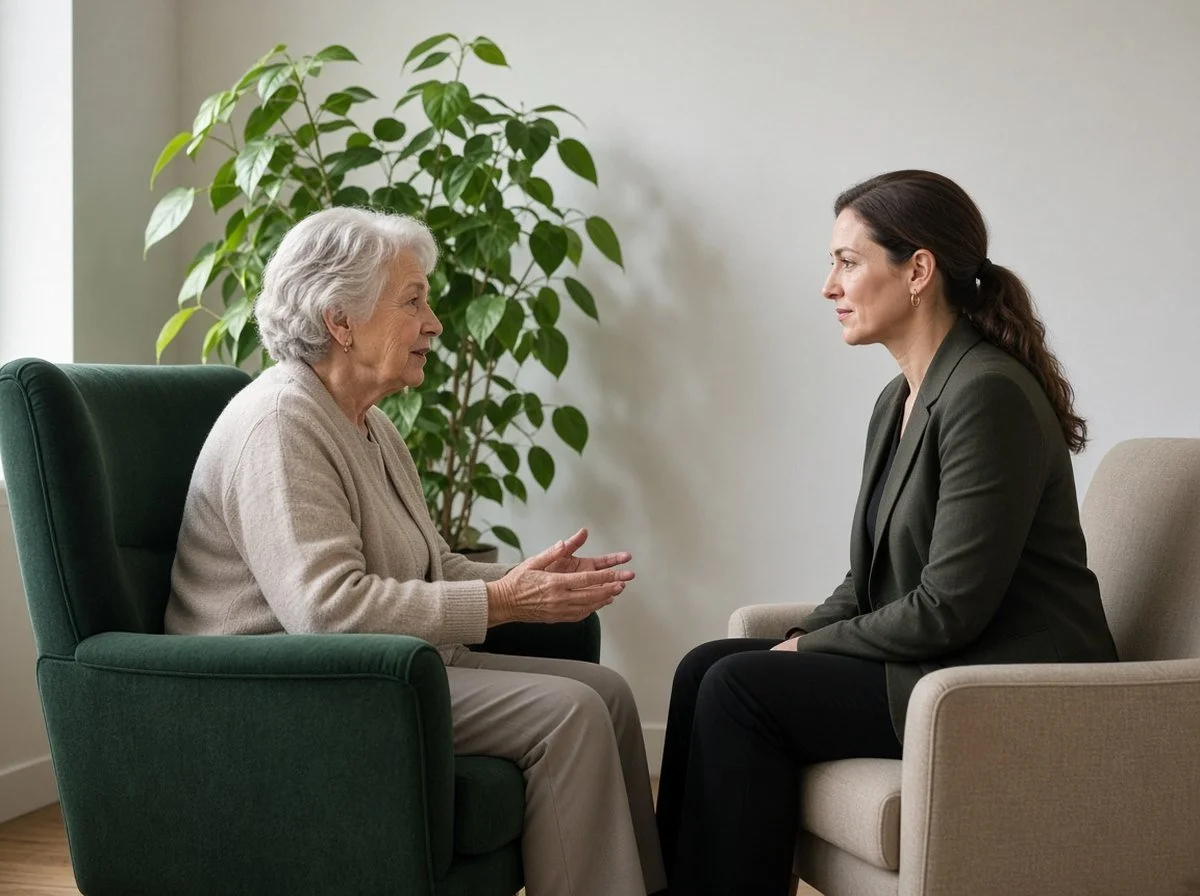
Counselling for seniors, in person or online
For counselling for seniors in Cambridge, we have two offices in Galt City Centre: 188 Main Street, N1R 1W8, and 73 Water St N, Suite 300, N1R 7L6. All of our offices are wheelchair accessible. We see adults of all ages, including adults 65 and older.
If getting out is hard, online counselling for seniors is an option from home. Online sessions use a secure video link sent by email, with nothing to download. Many people find it easier than they expected. Some people start online and switch to in person later.
You do not need to choose a counsellor on your own. When you book a free consultation for therapy for seniors in Cambridge, Ontario, our admin team will help match you with a therapist who works with older adults, in person or online.
If you are an adult child, you may want to help a parent get support. A few ideas:
Ask what they would want, and listen to the answer.
Offer to help with the booking or the video setup.
Let them have their sessions in private.
Respect their choice if they are not ready yet.
Cost, billing and your first step
Sessions with our therapists range from $130 to $200, depending on the clinician.
We accept Health Spending Accounts (HSAs).
We can direct bill many insurers. Coverage depends on your plan, so check with your insurer before you start.
Book a free 15-minute consultation with our admin team. We can help you or someone you love find a counsellor who works with older adults, in Cambridge or online.
If you're in crisis: if you or someone you love is in immediate danger, call 911. If you're thinking about suicide, call or text 9-8-8 any time, day or night.
Last reviewed: October 2026
Sources
National Institute of Mental Health. "Older Adults and Mental Health." https://www.nimh.nih.gov/health/topics/older-adults-and-mental-health
Cuijpers, P., and colleagues. "Psychotherapy for Depression Across Different Age Groups: A Systematic Review and Meta-analysis." JAMA Psychiatry. 2020. https://pmc.ncbi.nlm.nih.gov/articles/PMC7081149/
Kulakci Altintas, H., and Ercan Sahin, N. "Attitudes to aging, depression, and death anxiety among community-dwelling older adults: a cross-sectional correlational study." BMC Geriatrics. 2025. https://pmc.ncbi.nlm.nih.gov/articles/PMC12219969/
Donizzetti, A. R. "Ageism in an Aging Society: The Role of Knowledge, Anxiety about Aging, and Stereotypes in Young People and Adults." International Journal of Environmental Research and Public Health. 2019. https://pmc.ncbi.nlm.nih.gov/articles/PMC6517915/